You can't rank in ChatGPT the way you rank in Google, because ChatGPT has no fixed list of results. OpenAI says ChatGPT "ranks search results using multiple factors" and that "Placement is not guaranteed." You can influence three things: whether your site is eligible for ChatGPT search, whether your brand is mentioned on the pages ChatGPT reads, and whether your own pages are easy to quote.
This guide shows how to rank in ChatGPT and get cited by ChatGPT. It covers all three using OpenAI's own documentation and the studies that measured ChatGPT's citations, including where those studies disagree. Then it shows how to measure the result. Skygen is our product and is labeled where it appears.
Key takeaways
- To be eligible for ChatGPT search, allow OAI-SearchBot in robots.txt and let OpenAI's published searchbot IP ranges through your CDN. A robots.txt change can take about 24 hours to apply.
- ChatGPT search sometimes uses outside search providers and typically sends them rewritten queries; OpenAI's Enterprise and Edu help names Bing.
- Being named and being linked are different results. Mentions on YouTube and high spots on "best X" lists correlate with being named; review-site profiles correlate with being cited.
- Measure visibility as a share of answers over many runs. One check proves little.
Can you actually rank in ChatGPT?
Not in a fixed position. Ahrefs' guide says ChatGPT doesn't have rankings, "At least not in any traditional sense." SparkToro had 600 volunteers run 12 prompts through ChatGPT, Claude and Google's AI 2,961 times. It found "a <1 in 100 chance" of the same brand list in two ChatGPT responses, and about 1 in 1,000 for the same order.
So in SEO for ChatGPT, drop "position" and track two other things:
- Mentioned: your brand is named in the answer text. Ahrefs defines the goal as "the percentage of relevant queries where your brand gets mentioned at all."
- Cited: your page is linked as a source. In ChatGPT the two often don't line up. Semrush and Kevin Indig counted each time a domain appeared in an AI answer, as a source link, a brand mention or both. When a domain appeared in a ChatGPT answer, it was cited as a source 87% of the time. Its brand was named in the answer only 20.7% of the time.
SparkToro's conclusion is the useful one: "visibility % across dozens to hundreds of prompts run multiple times is a reasonable metric."
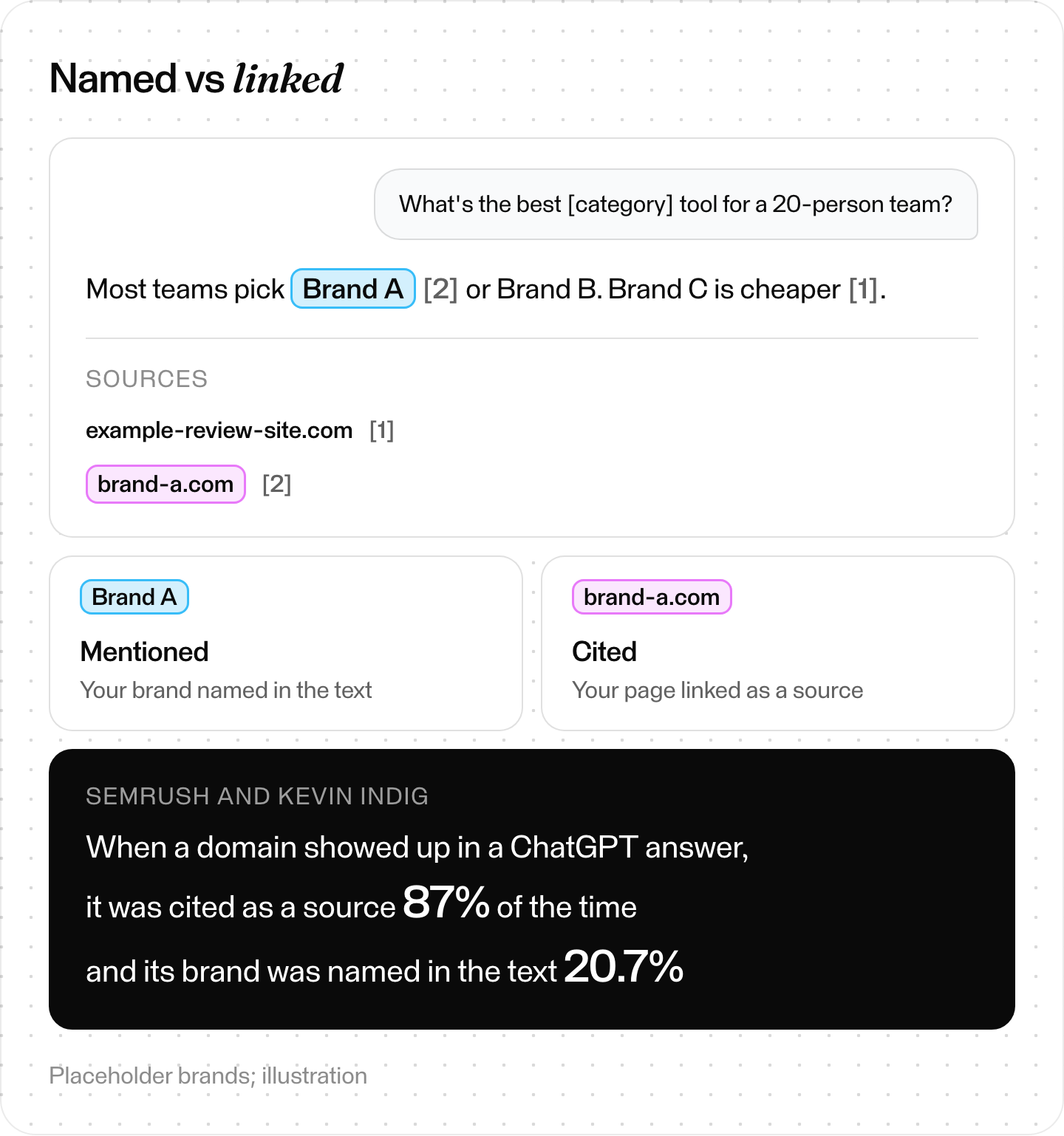
Mentioned vs cited, the two results to track. Placeholder brands; illustration.
How does ChatGPT choose what to cite?
ChatGPT searches when it thinks the question needs it. When it uses outside search providers, it sends them rewritten queries. Then it cites some of the pages it finds. Here is the chain in OpenAI's words, mostly from its help article on searching the web with ChatGPT:
- It decides to search. "ChatGPT may search the web automatically when your question would benefit from current information."
- It rewrites the question. "ChatGPT search typically rewrites your query into one or more targeted queries that it sends those providers," and "may send additional, more specific queries" after reviewing the first results.
- It sometimes uses outside providers. The consumer article links Microsoft's and Shopify's privacy policies. The Enterprise and Edu article is explicit: ChatGPT "may share disassociated search queries with the Bing search engine."
- It personalizes. It uses approximate location from your IP address. Memory can change the query: OpenAI's example is a vegan user in San Francisco whose search becomes "good vegan restaurants San Francisco."
- It cites some of what it finds. The Sources list shows "cited sources and other relevant links." For its developer search tool, OpenAI's API docs add: "The number of sources is often greater than the number of citations."
What the studies add:
- ChatGPT cites about half of the URLs it retrieves, across 1.4 million prompts Ahrefs analyzed. But most of the uncited half came from a separate Reddit feed. Pages from ordinary web search were cited 88% of the time.
- The same Ahrefs study reports Dan Petrovic's research: each retrieved result comes back with a page title, a short snippet, the URL and an ID. ChatGPT uses that data to decide which pages to open and cite.
- In Ahrefs' analysis of 118,931 fan-out queries, "Only 6.82% of ChatGPT search results are in the top 10 of Google's SERPs."
- For 3,311 head terms, Ahrefs found ChatGPT cited ranking domains about three times more often than the exact ranking pages (31.8% vs 10%).
Ranking for the exact query matters less than you'd think: ChatGPT often cites a different page on a domain that ranks. SE Ranking still found pages with better Google positions got more citations.
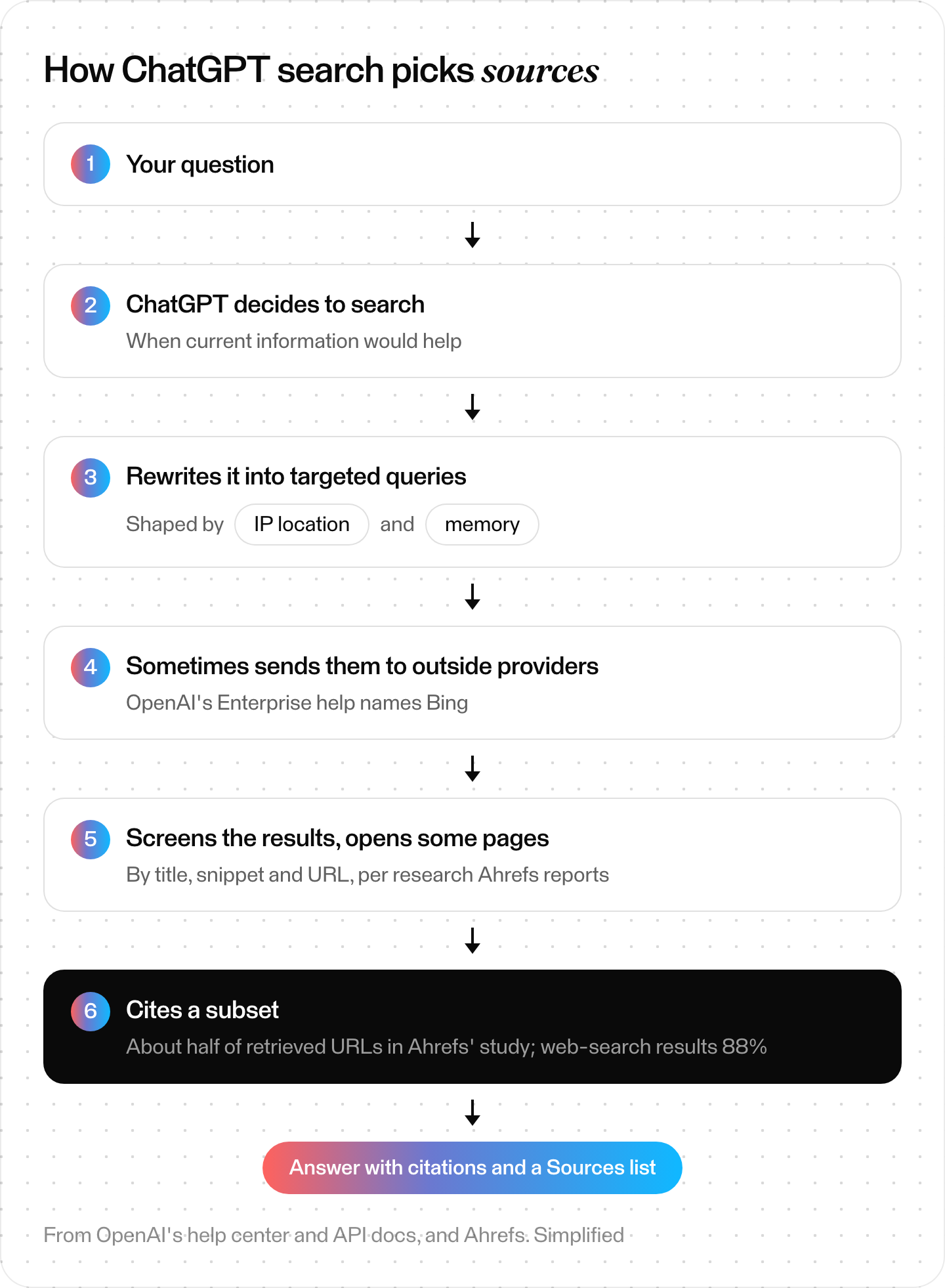
How ChatGPT search picks sources. From OpenAI's help center and API docs, and Ahrefs' research; simplified.
Step 1: How do you measure where you stand in ChatGPT?
Before you change anything, ask ChatGPT the unbranded questions your buyers ask, several times each and under the same conditions. Note whether each answer names you or cites your site, and which pages it cites. SparkToro, which found ChatGPT rarely repeats a brand list, calls the visibility share across many repeated prompts a reasonable metric.
- Write a set of unbranded buyer questions, the way a customer asks before they know you, such as best [category] for [use case].
- Fix the conditions. Location and memory can change answers, so run manual checks from the same place and network (no VPN switching) in a Temporary Chat.
- Keep the model and reasoning mode the same. In a Semrush test that ran 100 prompts twice, minimal and high reasoning shared only 25.6% of cited domains. Also decide whether you select Search yourself or let ChatGPT decide, and do the same every time.
- Run each question several times. One answer is an anecdote.
- For each answer, note whether you're named, whether your site is cited, and the exact URLs cited. Then work out two shares: answers that name you and answers that cite you.
What you should see: two baseline shares, named and cited, plus the third-party pages ChatGPT cites for your topic. That's your target list for Step 3.
For more than a handful of questions, use a tracker. Our guide to ChatGPT tracking tools compares ten on method and price.
Step 2: How do you make your site eligible for ChatGPT search?
You can't rank in ChatGPT search until your site is eligible, so ChatGPT search optimization starts here. OpenAI's help center spells out eligibility: "allow OAI-Searchbot to crawl the site and confirm that the website host or content delivery network allows traffic from OpenAI's published searchbot IP addresses."
OpenAI's crawler documentation lists four bots and treats each one separately. One of them, OAI-AdsBot, only visits pages submitted as ads. The other three matter here:
- OAI-SearchBot decides search. "Sites that are opted out of OAI-SearchBot will not be shown in ChatGPT search answers, though can still appear as navigational links."
- GPTBot crawls content "that may be used in training" OpenAI's models. Blocking it doesn't affect search.
- ChatGPT-User visits a page when a user's request triggers it. It "is not used to determine whether content may appear in Search."
A site can allow search and refuse training. OpenAI's own example (in prose) does exactly that, and in robots.txt it looks like this:
User-agent: OAI-SearchBot
Allow: /

User-agent: GPTBot
Disallow: /
Two more checks:
- Your CDN or firewall. OpenAI publishes its searchbot IP ranges at openai.com/searchbot.json. Make sure bot protection doesn't block them.
- Timing. OpenAI says it "can take ~24 hours from a site's robots.txt update for our systems to adjust."
Since OpenAI's Enterprise article names Bing, it's sensible to make sure Bing can index you too (our inference, not an OpenAI instruction). Bing's webmaster guidelines cover Copilot and "Grounding results and citations," and they ask you to use IndexNow when URLs change. They also warn against "Hiding critical content behind client-side rendering": content that "cannot be reliably rendered may not be indexed or selected for grounding results." IndexNow's list of participating engines doesn't include OpenAI.
What you should see: OAI-SearchBot allowed in robots.txt, its IP ranges not blocked, and your key pages indexed in Bing.
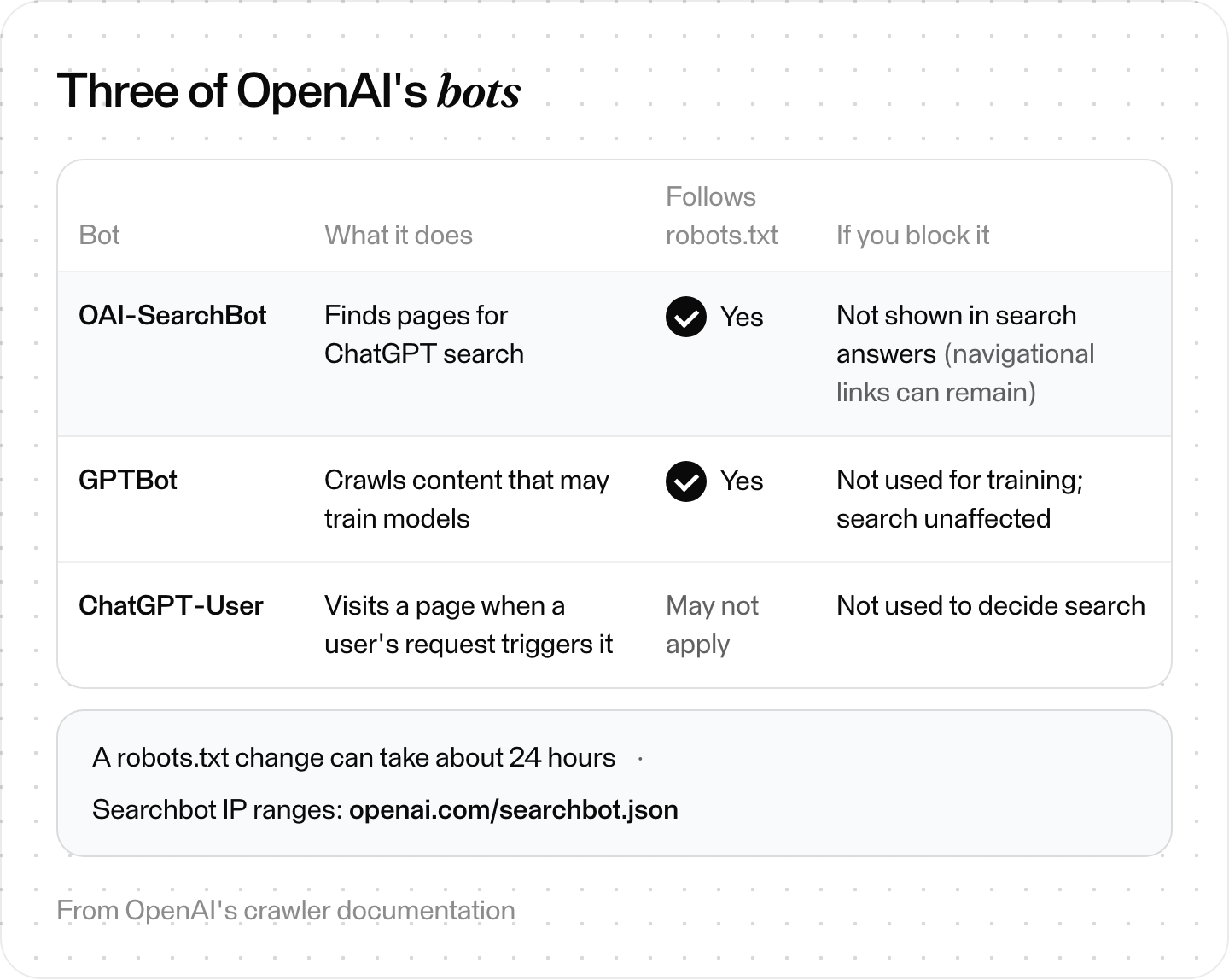
Three of OpenAI's bots and what robots.txt controls. From OpenAI's crawler docs.
Step 3: How do you get mentioned where ChatGPT looks?
Get mentioned on the pages ChatGPT already cites. The studies point the same way: brands other sites talk about show up more in its answers. In Ahrefs' study of 75,000 brands, "YouTube mentions show the strongest correlation with AI visibility (~0.737)," and "Branded web mentions still correlate highly with AI visibility (0.66-0.71)." Ahrefs stresses that correlation isn't causation.
Where to show up, and what the data says about each:
- Best-of lists. Ahrefs analyzed ChatGPT answers to 750 top-of-funnel prompts in software, products and agencies. In those answers, "best X" blog lists "represented 43.8% of all page types" among sources. 79.1% of the cited lists had been updated in 2025, and 35% sat on low-authority domains, many of which Ahrefs called "highly questionable."
- Reddit, Quora and review sites. SE Ranking found domains with millions of Quora and Reddit mentions averaged about 7 ChatGPT citations, versus 1.7 to 1.8 for minimal presence. Domains listed on several review platforms averaged 4.6 to 6.3, versus 1.8 for those absent.
- Wikipedia and LinkedIn. Ahrefs' September 2026 list of ChatGPT's most-cited sites (US queries) ranks reddit.com first and Wikipedia second. They hold 16.8% and 7.0% of the citations among its top sources. Semrush, in a study run with LinkedIn (325,000 prompts, January to February 2026), found LinkedIn in 14.3% of ChatGPT Search responses. Ahrefs' September 2026 list ranks it 38th.
The studies disagree on which single site matters most. They measure different things over different periods, and the mix moves. Profound's analysis of 680 million citations had Wikipedia at 7.8% of ChatGPT citations and Reddit at 1.8%. Semrush watched ChatGPT cite Reddit in close to 60% of responses in early August 2025 and around 10% by mid-September.
Don't bet on one platform. Start from the list of pages ChatGPT already cites for your questions (Step 1) and get onto those.
What you should see: for each cited page in your topic, a note on whether you're on it, and a plan to get there: a pitch to the list author, a review profile, a real answer in a thread.
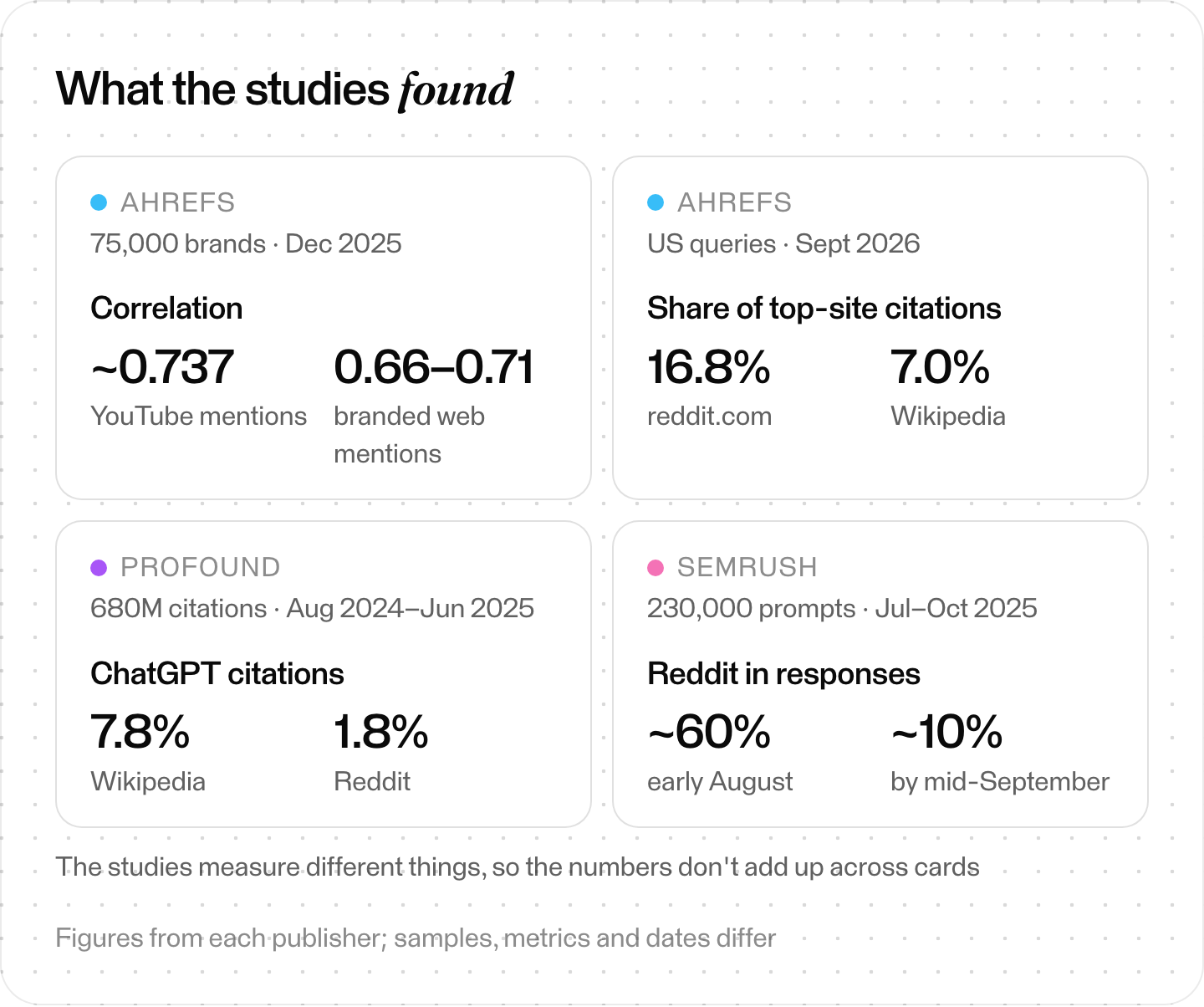
What four studies found: brand-mention correlations across three AI systems, and three measures of ChatGPT's most-cited sites. Samples, metrics and dates differ; figures from each publisher.
Step 4: How do you write pages ChatGPT can quote?
Once ChatGPT reaches your page, it needs a passage it can lift. Open each section with a short answer that stands on its own. Put key points early on the page, and back your claims with numbers and sources. Three findings line up behind this: an audit for Search Engine Land, Kevin Indig's research and the GEO paper.
- Answer first. For Search Engine Land, Adam Gnuse audited blog posts that got ChatGPT referrals (15 sites; posts without ChatGPT referrals weren't compared). The audit found that "72.4% of cited blog posts included an identifiable answer capsule": about 20 to 25 words right after the title or a question-style H2. "Over half (52.2%) featured either original data or branded-owned insight."
- Put it early. Ahrefs reports Kevin Indig's finding that "44.2% of all citations come from the first 30% of content."
- Cite, quote and count. The GEO paper (Aggarwal et al., KDD 2024) tested nine edits. The researchers' own engine fetched Google's top five results for each query and had GPT-3.5 write the answer from them. On that engine, the best edits, "Cite Sources, Quotation Addition, and Statistics Addition," raised the source's position-weighted word count in answers by 30 to 40%. They raised a model-rated impression score by 15 to 30%. A second test uploaded the source text to Perplexity as files and limited answers to them. There, Quotation Addition did best on the word-count measure, at 22%. "Keyword Stuffing" didn't help. Neither test used ChatGPT itself.
Ahrefs also found that cited pages had titles closer to ChatGPT's fan-out queries. In its data, results with natural-language URL slugs were cited 89.78% of the time versus 81.11% without.
Two areas where the studies need context, so don't over-fit:
- Question headings and FAQs. Ahrefs, summarizing Indig's research, says content with question marks in headings was cited at double the rate (18% vs 8.9%). SE Ranking looked at question-style page titles and H1s instead: those pages averaged 3.4 citations, versus 4.3 for straightforward headings. Its model still treats a missing FAQ section as a negative signal, and its advice recommends question-style subheadings.
- Length. SE Ranking found articles over 2,900 words averaged 5.1 citations versus 3.2 under 800 words. Evertune research, reported on LinkedIn, put the median cited page at 941 words. One compares citation counts by length; the other describes the typical cited page, so they answer different questions.
What you should see: every key page opens each section with a direct, self-contained answer, and states its claims with numbers and sources.
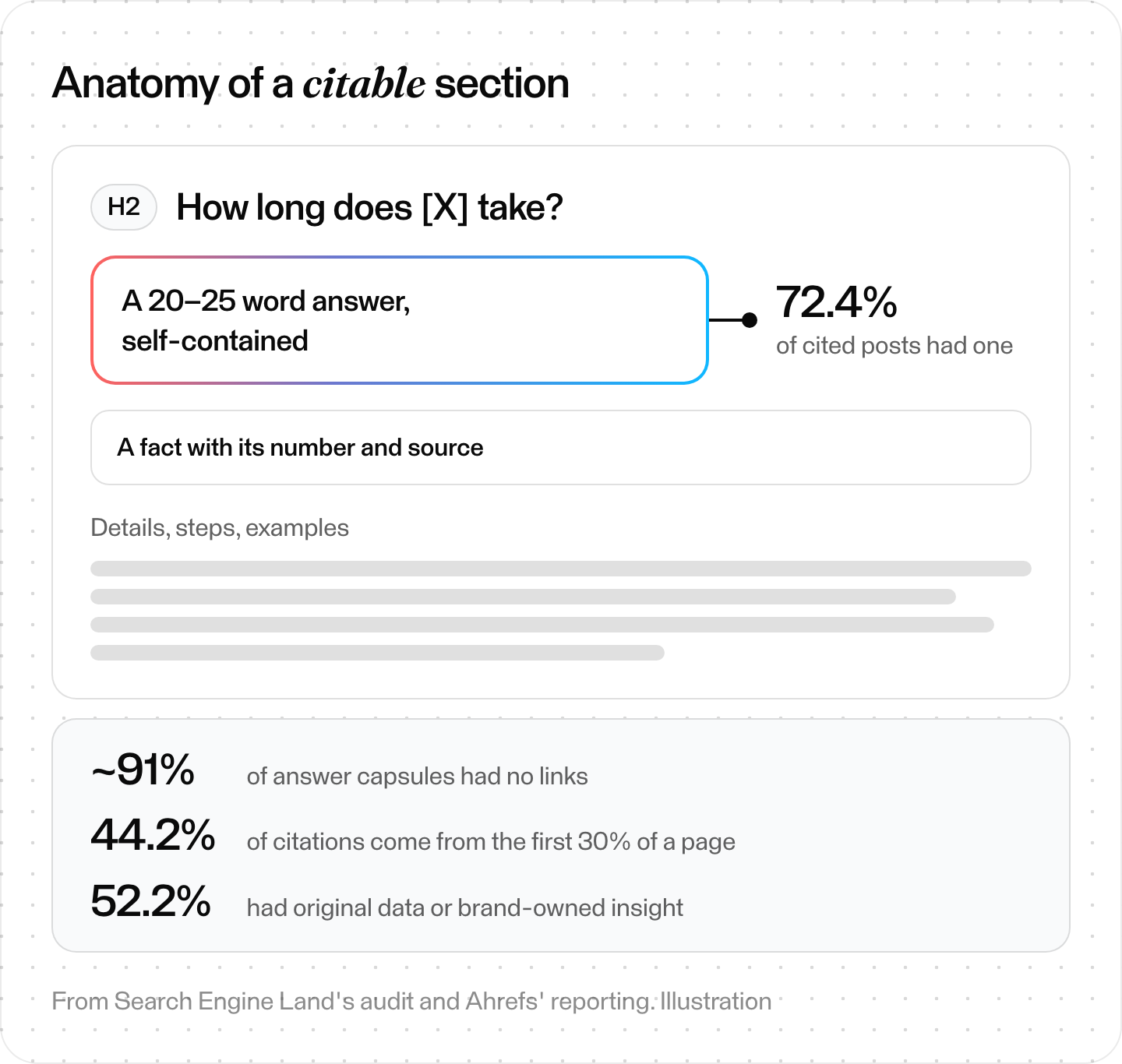
What cited pages had in common, from the Search Engine Land audit and Ahrefs' reporting. Illustration.
Step 5: How do you keep your best pages fresh?
Update the pages that matter when their facts change, and don't churn dates. Ahrefs analyzed about 17 million cited URLs and found AI assistants cite newer pages than Google's organic results. By publication date, ChatGPT's citations were the newest, 458 days newer than organic results on average. By last update, the gap was only 58 days.
SE Ranking found pages updated in the past three months averaged 6.0 citations versus 3.6. But Ahrefs' later study of 1.4 million prompts found that among the pages ChatGPT retrieved for one answer, the newest were the ones most often left uncited. It concluded that relevance does the heavy lifting, with freshness a tie-breaker mainly for news.
What you should see: a review date on each key page, and real changes behind each update.
Step 6: If you sell products, how do you get into ChatGPT shopping?
You get in through your product data: Shopify Catalog if you sell on Shopify, or a direct feed if OpenAI approves you. Shopping answers have their own rules. OpenAI's help center says "Product results are selected independently by ChatGPT and are not ads, nor influenced by any OpenAI partnerships."
When several merchants sell a product, ChatGPT ranks them on factors such as availability, price, quality and whether the merchant is the maker or main seller.
- Shopify stores reach ChatGPT through Shopify Catalog, with no extra work, per OpenAI.
- Other merchants can apply for direct product-feed access at chatgpt.com/merchants. OpenAI's commerce docs say onboarding is limited to approved partners.
- In the feed, nine fields are required (item_id, title, description, url, brand, seller_name, image_url, availability, price). Recommended attributes, such as rich media, reviews and performance signals, "improve ranking, relevance, and user trust."
What you should see: complete product data with a real brand and seller name, and reviews where your platform supports them.
Step 7: How do you track ChatGPT referrals and repeat the checks?
Each month, review ChatGPT referrals, then rerun your Step 1 questions on the same settings and compare. OpenAI's publisher FAQ said "ChatGPT automatically includes the UTM parameter utm_source=chatgpt.com in referral URLs." That page now redirects to a help article about ChatGPT Atlas's retirement, so check your own analytics for the parameter rather than assuming it.
Watch two more things:
- Broken pages. Ahrefs checked 16 million URLs cited by AI assistants: 2.38% of URLs ChatGPT cited returned 404, against a 0.84% baseline for Google. Redirect dead URLs that still get ChatGPT clicks.
- The channel's size. Across 60,000+ websites Ahrefs tracks, ChatGPT sends 8 to 9 times the referral traffic of Perplexity, the next AI-first platform.
What you should see: a monthly read of ChatGPT referrals and both shares from Step 1, next to a dated log of your changes. Our read: treat a change after an edit as a lead to test, not proof that the edit caused it.
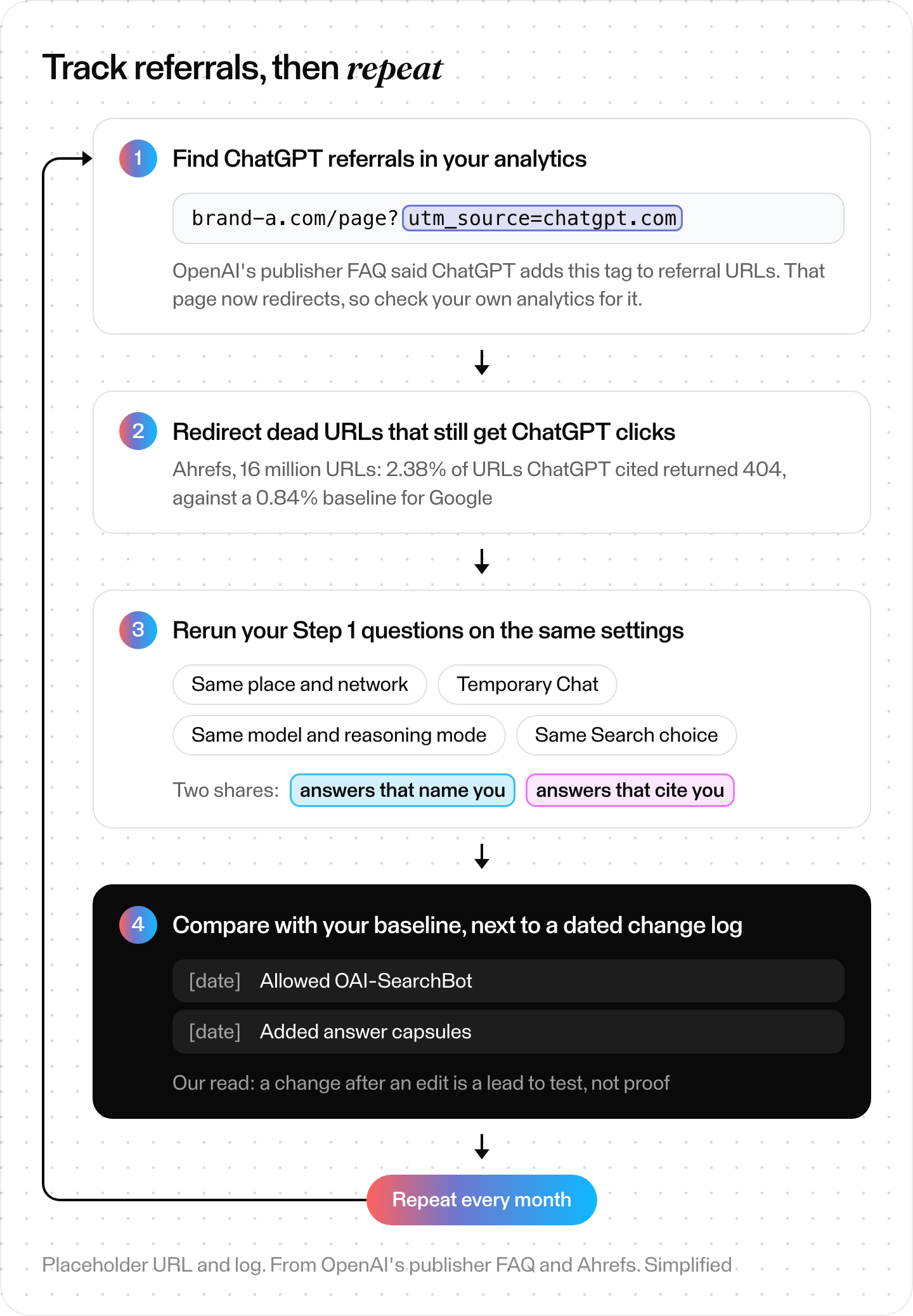
Step 7 as a monthly loop. Placeholder URL and log entries; from OpenAI's publisher FAQ and Ahrefs. Illustration, simplified.
Why isn't ChatGPT citing my website?
If ChatGPT never cites you, not even for your brand name, check access first. OpenAI's help center makes eligibility depend on allowing OAI-SearchBot and traffic from its searchbot IP addresses. If you're named once and gone the next time, that's normal variation, which SparkToro measured. Work down the table below before you rewrite anything.
| Problem | What to check |
|---|---|
| Never cited, not even for your brand name | robots.txt allows OAI-SearchBot, and your CDN doesn't block OpenAI's searchbot IP ranges. A robots.txt change can take about 24 hours to apply. |
| Named in one test, gone in the next | Normal variation. SparkToro found ChatGPT rarely repeats the same brand list. Judge the share of answers over many runs. |
| Cited, but not named in the text | A "ghost citation." Strengthen what the cited page says about you, and get named on the third-party pages ChatGPT cites. |
| A cited link doesn't support the answer | OpenAI warns "Search results and citations can be incomplete, outdated, or incorrect." Open the source and fix your page if it's yours. |
| ChatGPT sends visitors to a dead URL | Redirect it. Ahrefs found ChatGPT cites 404 pages more often than Google links to them. |
| Your product shows the wrong price or stock | Your product feed or structured data. OpenAI's feed requires price and availability. |
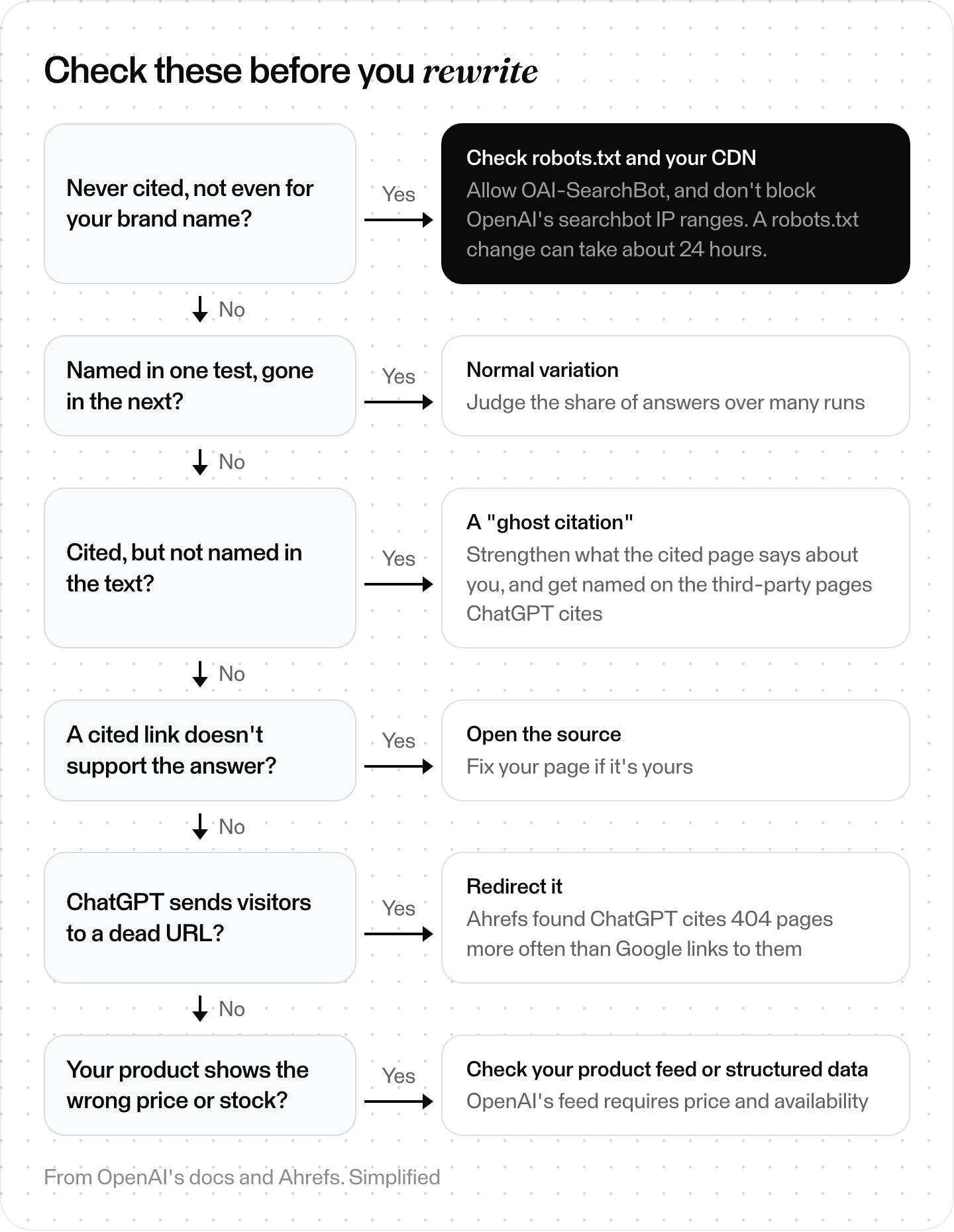
What to check, in order, before you rewrite anything. From OpenAI's docs and Ahrefs. Illustration, simplified.
What doesn't help, or has no evidence
- llms.txt. SE Ranking checked nearly 300,000 domains: "There's no correlation between AI citations and LLMs.txt." OpenAI's developer docs publish an llms.txt of their own, but we found no OpenAI statement that it affects ChatGPT search.
- FAQ schema as a trick. SE Ranking found pages with FAQ schema averaged 3.6 citations versus 4.2 without. Bing says structured data "may support clearer grounding but does not guarantee visibility."
- Keyword stuffing. In the GEO paper's Perplexity test, run on uploaded source files, it "performs 10% worse than the baseline."
- Hidden instructions for the model. Bing warns that content "designed to manipulate or interfere with language models used by Bing or Copilot" may lead to "reduced visibility or removal." We found no OpenAI statement on it.
- Buying ads. OpenAI says "Ads do not influence the answers ChatGPT gives you." Ads sit outside the answer. Our ChatGPT ads guide covers them.
Where Skygen fits (our product)
Disclosure first: Skygen is ours. Its AI visibility check automates the asking and counting in Step 1 and the reruns in Step 7, through model APIs. ChatGPT, Claude, Gemini, Grok and Perplexity get the same questions, and the check records what each answer says about you. The full workspace also tracks which competitors the answers name.
- Free first check: up to 3 grounded questions built from your website, across all five assistants, with no credit card.
- Workspace: the agent proposes 20 questions to start; you can edit them and add your own, up to 150. Each answer is marked recommended, mentioned, dismissed, cited but not named, not named or not measured.
- Fair comparisons: a change shows after two comparable runs, and Skygen compares runs only when the questions, model and search mode match. A failed answer is recorded as "not measured," never as "not named."
- Repeats: weekly by default, or a daily pulse of five questions, within your plan's monthly allowance. Each question asked of each assistant uses one AI answer check, so 20 questions asked of five assistants use 100.
- Plans: recurring AI answer checks come with Organic Pro at $799 a month (300 checks), Organic Superior at $2,000 (1,200 checks) and All-in-one at $7,000 (3,000 checks).
Our read: it takes the asking and counting in Steps 1 and 7 off your hands, every week.
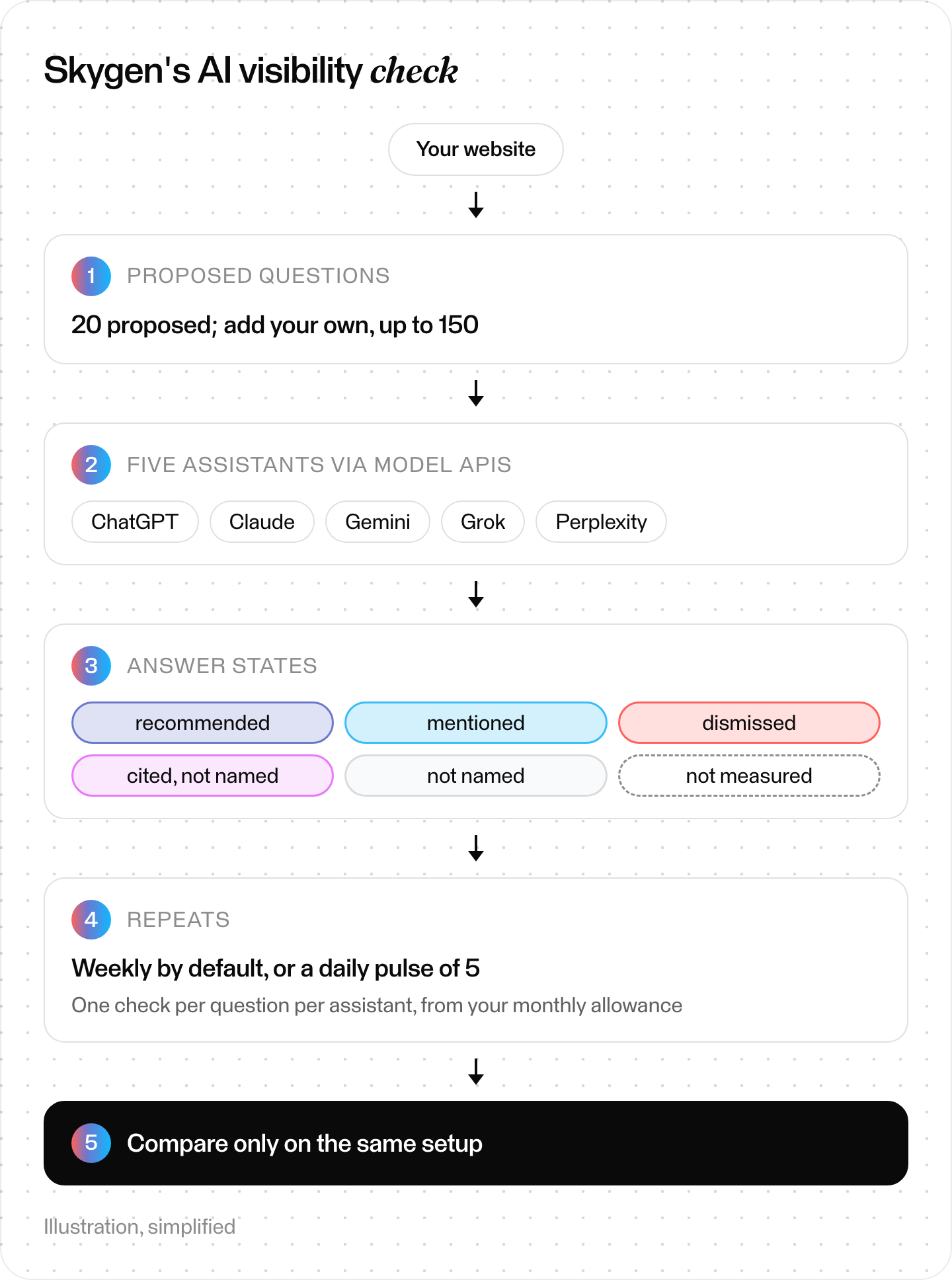
Skygen's AI visibility check. Illustration, simplified.
How to rank in ChatGPT: the short version
Allow OAI-SearchBot and OpenAI's published searchbot IP ranges. Make sure Bing can index you. Find the pages ChatGPT already cites for your buyers' questions and get onto them: lists, reviews, forums, YouTube. Open each key section with a short, self-contained answer, then back it with numbers and sources. Then measure visibility as a share of answers across many runs, not as a position.