
The right Instantly alternative depends on which part of your Instantly bill you want to change. Instantly isn't one subscription. Sending, lead credits, the CRM and inbox-placement tests are separate subscriptions, though sending and credits also come as bundles. Done-for-you mailboxes cost extra. Several alternatives fold those pieces into one plan, or leave out the parts you don't use.
Below, we show what each piece of Instantly costs and compare 10 alternatives from their own pages, read on October 24, 2026 (Reply.io from an archived copy dated October 16). Then come the free options and what happens to your domains when you leave. Skygen is our product and is labeled where it appears.
Key takeaways
- Instantly's sending plans run $47 to $358 a month, and credits, CRM and inbox tests are separate subscriptions. Price the whole stack, not one plan.
- Webhooks and replying from Unibox start on Hypergrowth ($97). The trial connects only 2 email accounts.
- Instantly keeps ownership of done-for-you domains. They don't leave with you.
- For LinkedIn in the same campaign, look at lemlist or QuickMail. For data plus sending, Apollo or Saleshandy. For free plans, Hunter or Snov.io.
Instantly pricing: what do you actually pay for?
On Instantly, you pay for up to five separate things: sending, lead credits, the CRM, inbox-placement tests and done-for-you mailboxes. Instantly's help center says it "has several separate subscription types, each billed individually: Outbound, Data Credits, CRM, and Inbox Placement," and "Each workspace requires its own subscription." The sending plans alone run $47 to $358 a month.
| Layer | What it is | Price as displayed (monthly billing) |
|---|---|---|
| Outreach | Sending: uploaded contacts (a fixed cap) and emails per month | Growth $47, Hypergrowth $97, Light Speed $358 |
| Credits | Lead Finder (formerly SuperSearch), Copilot and AI agents | Nano $9, Growth $47–77, Supersonic $97–147, Hyper $197+ |
| CRM | Pipeline and deals | Growth CRM $47, Hyper CRM $97 |
| Inbox Placement | Deliverability tests | $47, or $97 with automated tests |
| Done-for-you mailboxes | Domains and accounts Instantly sets up | $15 per domain a year; $5 a month per Google account, $10 pre-warmed, $4 AirMail |
The Outreach plans work like this, per Instantly's pricing page:
- Growth: $47 a month ($37.6 billed yearly), 1,000 uploaded contacts and 5,000 emails.
- Hypergrowth: $97 a month ($77.6 yearly), 25,000 contacts and 125,000 emails. The same page's comparison table says 100,000, so check before you count on the higher figure.
- Light Speed: $358 a month ($286.3 yearly), 100,000 contacts and 500,000 emails, plus dedicated server and IP blocks.
Instantly's pricing page lists "unlimited email accounts" on all plans, but its terms say it "currently offers a maximum of one hundred (100) Connected Accounts per workspace." The same page lists automated warmup on every plan. The uploaded-contacts number is "a fixed limit across all campaigns, not per month."
Bundles combine sending and credits: Starter at $94 a month, Scale at $194 and Agency at $555, about 10% less on yearly billing.
A worked example, our arithmetic from the list prices: Hypergrowth ($97) plus the cheapest Growth credits tier ($47) plus Growth CRM ($47) comes to $191 a month. That's before any done-for-you mailboxes.
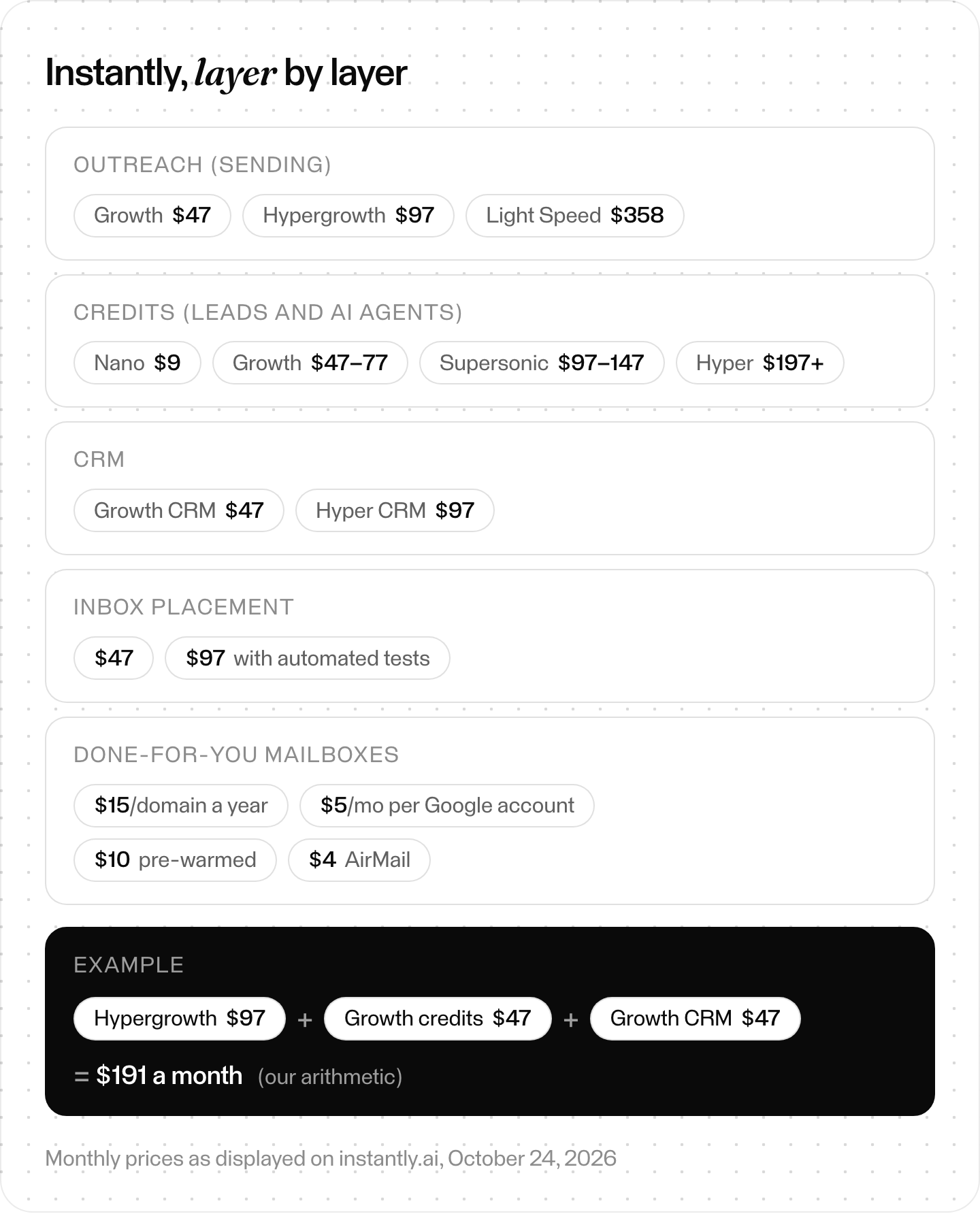
Instantly's separate subscriptions as displayed on October 24, 2026. The total is our arithmetic.
Why do teams look for Instantly alternatives?
Our read of Instantly's own pages: six limits push teams toward Instantly alternatives. Webhooks and replying from Unibox start on Hypergrowth ($97). Credits, the CRM and inbox tests are extra subscriptions, and unused credits expire. Instantly's pages mention LinkedIn in its CRM add-on, not as campaign steps. Done-for-you domains stay Instantly's, and its terms say fees are non-refundable.
- Key features sit on the $97 plan. "Webhooks are gated to Hypergrowth and above," and on Growth the Unibox is preview-only. Replying from it starts on Hypergrowth.
- The stack adds up. Credits, CRM and inbox tests are extra subscriptions.
- Credits expire. Unused credits expire 2 months after purchase on monthly plans, 1 year on annual.
- You want LinkedIn steps in your campaigns. Instantly's pages mention LinkedIn as connections you manage in its separate CRM add-on, not as campaign steps.
- You want to own your domains. Done-for-you domains stay Instantly's.
- The fine print. Instantly's terms say fees are non-refundable, including for credits and done-for-you services, and that subscriptions renew automatically. The same section asks for 30 days' written notice before a term ends. But it says self-serve plans are cancelled in account settings "or such other mechanism as Instantly designates," effective at the end of the billing period, and that messages to support don't count as notice. Its help center, though, says Outbound and Data Credits add-ons are cancelled through chat support before the renewal date.
How we compared these Instantly alternatives
We read each vendor's own pages on October 24, 2026: pricing pages for all ten, plus product, help-center or terms pages where they answer a question. Every price and limit below comes from those pages. For Skygen, we also checked saved copies of its production code. We didn't run campaigns or test deliverability. If you're choosing the best cold email software from scratch rather than leaving Instantly, the same comparison applies.
- Prices are as displayed, with the billing period each page shows. Hunter showed us euro prices; we quote them as shown. Reply.io blocked our reader, so its figures come from an archived copy of its pricing page dated October 16, 2026.
- Not stated means the pages we read don't say. It isn't proof a feature is missing.
- Disclosure: Skygen is our product. We read seven lists for this search: six in Google's top 10, plus reachinbox.ai, which the AI Overview cites. Five of them put their own product or a sister product first.
Instantly alternatives at a glance
Entry plans as displayed on October 24, 2026 (Reply.io: archived copy of its pricing page, October 16, 2026).
| Tool | Entry price | Entry sending limit |
|---|---|---|
| Instantly (for reference) | Growth $47/mo | 5,000 emails, 1,000 contacts |
| Smartlead | Base $39/mo | 6,000 sends, 2,000 contacts |
| lemlist | Email $55/mo yearly ($69) | 50,000 emails |
| Apollo.io | Free; Basic $49/seat annual, $65 monthly | Not stated per plan |
| Reply.io | $49/user/mo annual, $59 monthly | 1,000 active contacts |
| Woodpecker | Email $39/mo ($26 annual) | 5,000 emails |
| Saleshandy | Starter $41/mo ($34 annual) | 6,000 emails |
| Snov.io | Starter $39/mo ($29.25 annual) | 5,000 recipients |
| Mailshake | Starter $29/mo ($25 yearly), billed by users | 1,500 sends |
| QuickMail | Starter $49/mo | 5,000 emails |
| Hunter Sequences | Free; Starter 49€/mo (34€ yearly) | Free: 1 email account |
| Skygen (ours) | Outreach Pro $2,000/mo | 10,000 approved emails, counting follow-ups |
Lead data and free options, from the same pages:
| Tool | Lead data | Free plan or trial |
|---|---|---|
| Instantly (for reference) | Separate credits plan | 14-day trial, 2 accounts |
| Smartlead | Verified emails: $59/mo add-on on Base | Free trial, no card |
| lemlist | 650M+ leads (its claim) | 14-day trial |
| Apollo.io | 240M+ contacts (its claim) | Free plan, Gmail only |
| Reply.io | 50 live-data credits/mo | 14-day trial |
| Woodpecker | 100 Lead Finder credits | 14-day trial, no card |
| Saleshandy | 852M+ contacts (its claim) | 7 days, 100 emails |
| Snov.io | Own prospect database | Free Trial plan, renews monthly |
| Mailshake | 50 free Data Finder credits; paid add-on | No trial |
| QuickMail | Not stated | 14 days, card needed, no auto-charge |
| Hunter Sequences | Discover database | Free plan |
| Skygen (ours) | Third-party people directory, plus Dossier research | No free plan shown |
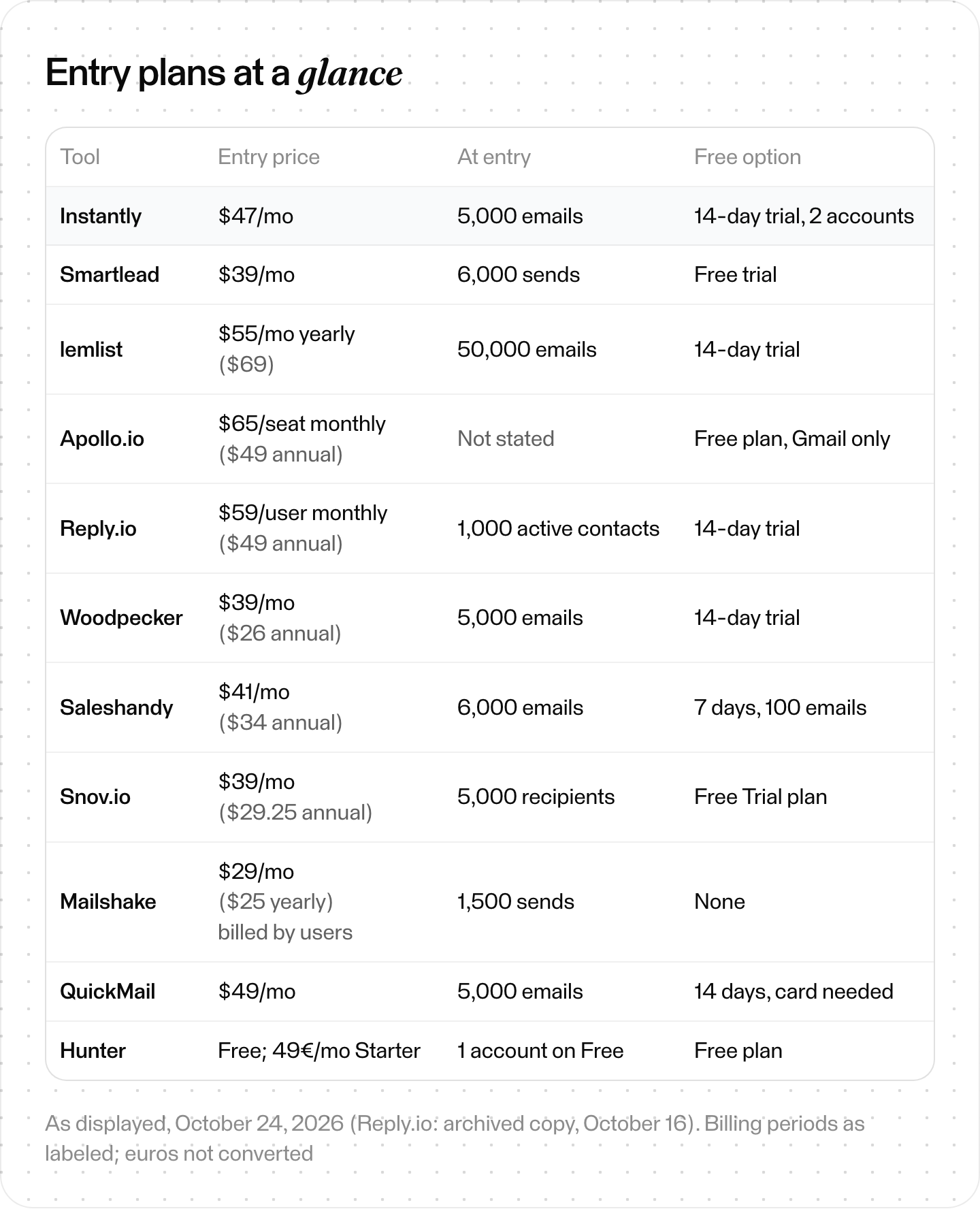
Entry plans as displayed on vendor pages, October 24, 2026 (Reply.io: archived copy, October 16). Billing periods as labeled; euros not converted.
Is there a free Instantly alternative?
Yes, for small volumes. Hunter Sequences, Snov.io and Apollo.io all show free plans on their pricing pages. Instantly itself has no free plan, only a 14-day trial. Its help center says the trial needs no card and is limited to 2 email accounts, 250 leads and 1,000 emails.
When the trial ends, "Your warmup and accounts will be paused automatically," and a trial account that wasn't upgraded "will be automatically deleted after expiration."
Free options from the alternatives:
- Hunter Sequences: a free plan that connects one Gmail or Outlook account, with follow-ups and scheduling, 50 credits a month and 500 recipients per sequence.
- Snov.io: a free Trial plan that renews every month, with 50 credits, 100 recipients and one warm-up slot, but no A/B tests, API or export.
- Apollo.io: a Free plan with no time limit. Email campaigns are included, but free plans connect Gmail accounts only.
Warm-up is thin on free plans. Snov.io's Trial includes one warm-up slot. Hunter's warm-up is a paid add-on for paid plans only, and Apollo's Free plan card doesn't list warm-up (Basic does). Budget time to warm new domains.
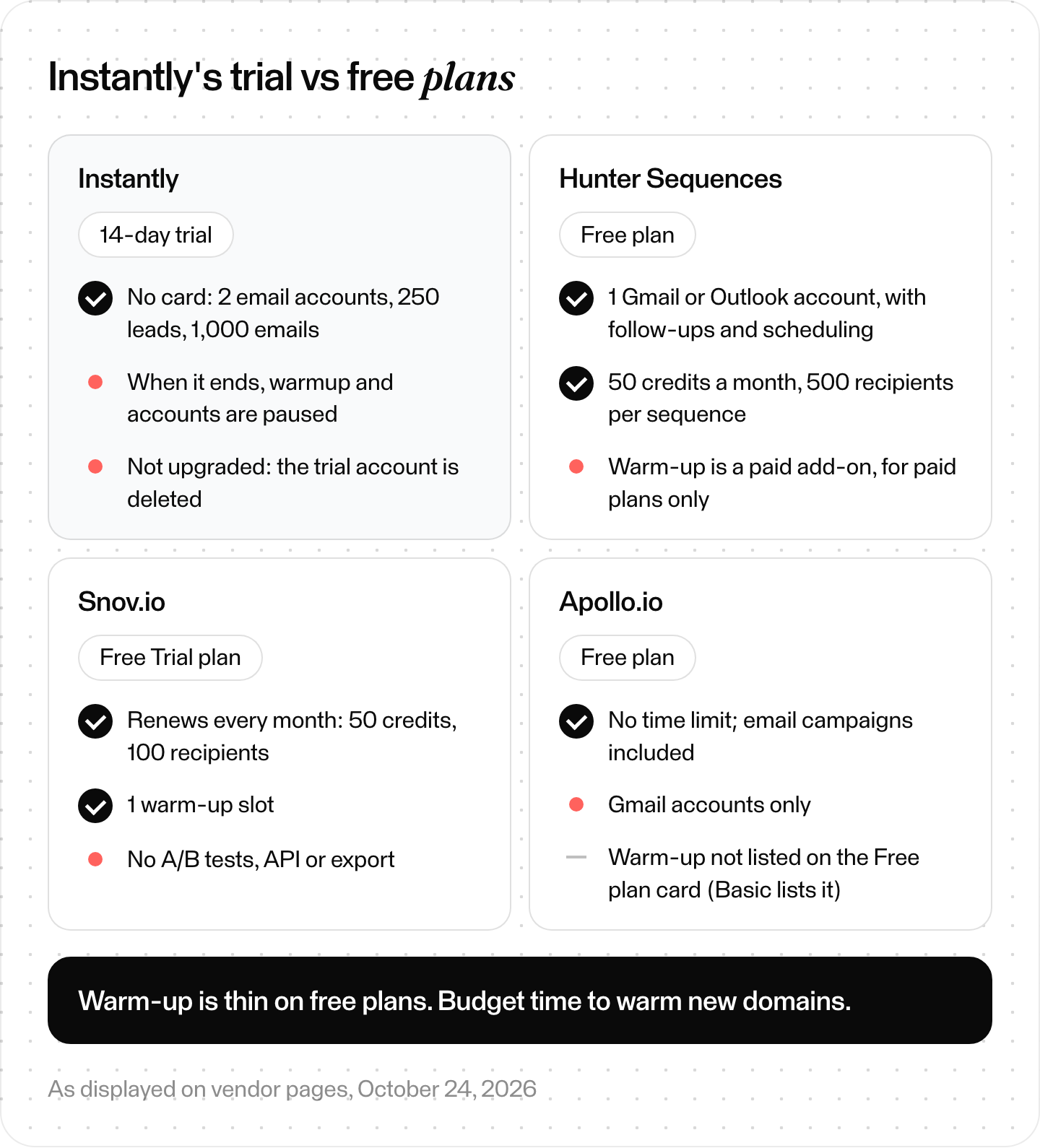
Instantly's 14-day trial vs three free plans, as displayed on vendor pages, October 24, 2026.
What are the best Instantly alternatives and competitors?
Our read: the best Instantly alternative depends on what you need. We compared 10 from their own pages: Smartlead, lemlist, Apollo.io, Reply.io, Woodpecker, Saleshandy, Snov.io, Mailshake, QuickMail and Hunter Sequences. lemlist and QuickMail add LinkedIn steps to the same campaign. Apollo and Saleshandy bundle a lead database with sending. Hunter, Snov.io and Apollo have free plans.
Each entry covers who it suits, the entry plan, how it differs from Instantly and what to watch out for. "Best for" is our read of each vendor's own pages. Prices are as displayed on October 24, 2026, except Reply.io's, which come from an archived copy of its pricing page dated October 16, 2026.
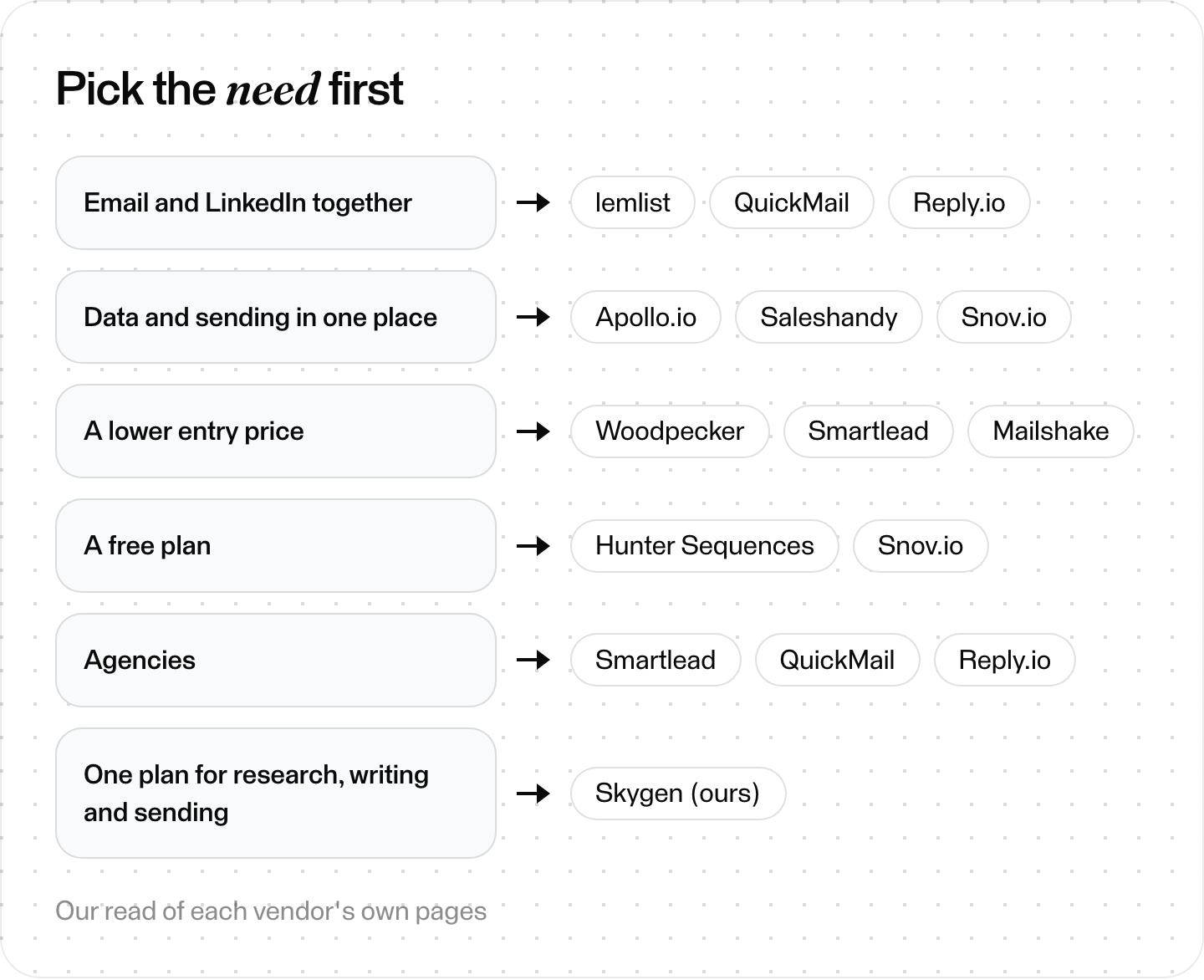
Pick the need first, then the tool. Our read of each vendor's own pages, October 24, 2026.
1. Smartlead
- Best for: agencies sending high volume over email.
- Entry plan: Base at $39 a month for 2,000 contacts and 6,000 sends, with unlimited email accounts, per its pricing page. Pro is $94.
- Priced by: send volume and verified leads, "not per seat and not per mailbox."
- vs Instantly: priced by send volume. Verified prospect emails are a $59-a-month add-on on Base and Pro and included from Unlimited Smart up; Instantly bills lead credits as a separate subscription. Both offer white-label: Smartlead charges $29 a month per client workspace from Pro up, while Instantly includes an agency portal on Hypergrowth and Light Speed. API and webhooks start on Pro.
- Watch out for: domains bought through its SmartSenders "can't be transferred," same as Instantly's. See our Smartlead alternatives guide for its full pricing.
2. lemlist
- Best for: personalized campaigns across email and LinkedIn.
- Entry plan: Email at $55 a month on yearly billing ($69 undiscounted), per its pricing page. It includes unlimited users and senders at 50,000 emails a month.
- LinkedIn: the Multichannel plan ($87 per user a month, billed yearly) adds LinkedIn profile visits, invitations, messages and InMails. The page is inconsistent on SMS: the plan card lists SMS automation, while its FAQ calls SMS an add-on.
- vs Instantly: its lead database (650M+, by its pricing page) comes with the plan, and enrichment credits are an add-on. Warm-up (lemwarm) is included on all plans, as on Instantly.
- Watch out for: no white-label or client portal on its pricing page.
3. Apollo.io
- Best for: teams that want data and sequences in one place.
- Entry plan: Free; Basic at $49 per seat a month billed annually or $65 monthly, per its pricing page.
- Lead data: its own database of 240M+ contacts, by Apollo's figure. From Basic up, plans list a deliverability suite with warm-up, plus domain and mailbox purchasing.
- vs Instantly: data and sending on one subscription priced per seat, instead of Outreach plus Credits.
- Watch out for: credits expire each billing cycle, and standard plans are for internal use only.
4. Reply.io
- Best for: teams that want email, LinkedIn, calls and SMS, or an agency plan.
- Entry plan: Email Volume at $49 per user a month billed annually ($59 monthly), per an archived copy of its pricing page. It includes unlimited mailboxes under its fair-usage policy.
- LinkedIn: a $69-a-month add-on per account, or Multichannel from $89 per user a month billed annually.
- vs Instantly: Agency Core covers unlimited clients with an optional white-label, from $210 a month on its plan card (the page's comparison table says from $166). Its Jason AI SDR starts at $500 a month.
- Watch out for: Email Volume is priced per user up to 5,000 active contacts a month; larger tiers list unlimited users.
5. Woodpecker
- Best for: small teams that want a low, predictable price.
- Entry plan: Email at $39 a month, or $26 billed annually, for 5,000 emails, per its pricing page. It includes unlimited contacts, verification, team members and email accounts.
- LinkedIn: Multichannel adds $29 a month per LinkedIn account to the Email tier's price.
- vs Instantly: unlimited contact storage on the entry plan, where Instantly Growth caps uploaded contacts at 1,000.
- Watch out for: only 3 warm-ups on the entry tier.
6. Saleshandy
- Best for: budget sending with a built-in lead database.
- Entry plan: Starter at $41 a month ($34 annually), per its pricing page: 6,000 emails, 2,000 active prospects and 1,500 Lead Finder credits.
- Included on every plan: unlimited email accounts, warm-up and a unified inbox.
- vs Instantly: lead credits come inside the plan, not as a second subscription. One credit reveals an email; a phone number takes 6.
- Watch out for: the trial lasts 7 days and caps sending at 100 emails.
7. Snov.io
- Best for: small teams that want a CRM, database and sending without extra subscriptions.
- Entry plan: Starter at $39 a month or $29.25 billed annually, per its pricing page, with 1,000 credits, 5,000 recipients and unlimited team seats.
- Included: Unibox, mailbox rotation, unlimited senders and a built-in sales CRM.
- vs Instantly: you pay per "recipient," and follow-ups to the same person in the billing period are free.
- Watch out for: LinkedIn automation is a separate subscription at $69 a month per slot, or $62 billed annually. With a Sales Suite plan such as Starter, each slot is $10 less.
8. Mailshake
- Best for: founders sending modest volume.
- Entry plan: Starter at $29 a month ($25 yearly), per its pricing page. It includes 1 email address, 1,500 sends a month, unlimited warmup and 50 free Data Finder credits.
- Priced by: users, per its FAQ: billing "is based on how many users you purchase," and each paid user connects one mail account. The plan cards don't say whether their prices are per user, and the Email Outreach card lists 2 email addresses per account. Confirm your team's total before you buy.
- Next step up: Email Outreach at $49 a month adds rotation and a unified inbox.
- vs Instantly: lower entry price, far lower volume.
- Watch out for: no free trial; payment is collected up front.
9. QuickMail
- Best for: agencies running email and LinkedIn together.
- Entry plan: Starter at $49 a month, per its pricing page. It includes unlimited email senders, LinkedIn accounts and users, 1,000 uploaded contacts and 5,000 emails.
- Included: a free AutoWarmer via MailFlow on all plans.
- vs Instantly: LinkedIn and email run in the same campaign.
- Watch out for: no lead database on its pricing page; QuickMail says it doesn't provide lead-generation services.
10. Hunter Sequences
- Best for: testing cold email for free, or adding sequences to Hunter's email finder.
- Entry plan: a Free plan with one connected account. Its pricing page shows Starter at 49€ a month, or 34€ billed yearly, with 2,000 credits and 3 email accounts.
- Lead data: Hunter's own database, Discover, with advanced filters on paid plans.
- vs Instantly: there's a free plan, and unlimited users on all plans.
- Watch out for: warm-up is a paid add-on at $7.50 per email account a month.
Instantly vs lemlist: which should you pick?
Our read: pick lemlist for LinkedIn steps or a lead database included in the plan. lemlist's pricing page puts LinkedIn steps on its Multichannel plan, priced per user. Pick Instantly if you'd rather add lead credits, a CRM or inbox tests as separate plans only when you need them. Both include warmup.
| Instantly | lemlist | |
|---|---|---|
| Entry plan | Growth $47/mo: 5,000 emails | Email $55/mo yearly: 50,000 emails |
| Connections managed in its CRM add-on | Steps on the Multichannel plan | |
| Lead database | 450M+ contacts (its claim), separate credits | 650M+ leads (its claim), in the plan |
| Users | Team invites from Hypergrowth; one subscription per workspace | Unlimited users on the Email plan |
| Trial | 14 days, 2 email accounts | 14 days, 200 credits |
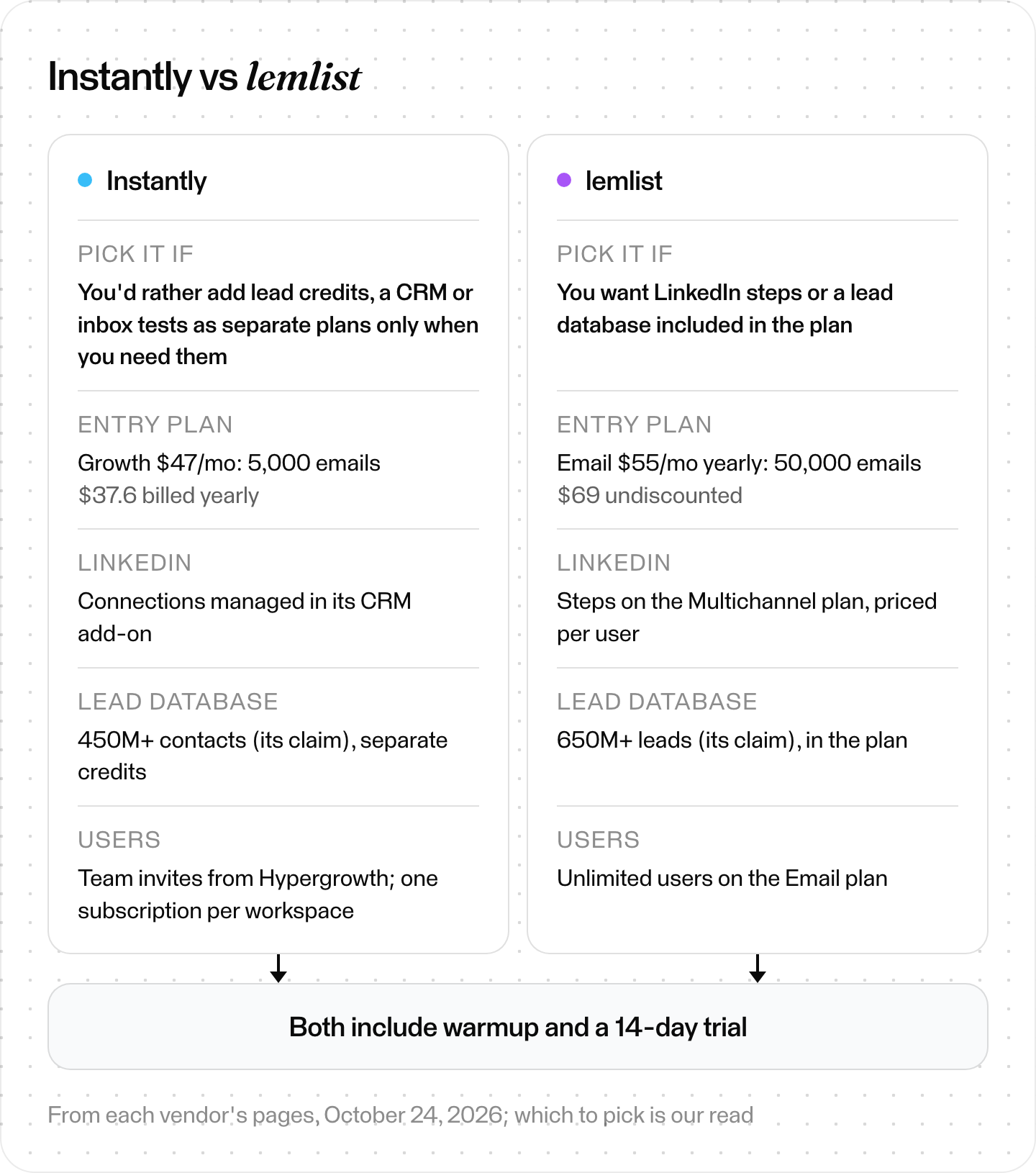
Instantly vs lemlist, from each vendor's pages on October 24, 2026. Which to pick is our read.
Who owns your domains when you leave Instantly?
Instantly owns domains bought through its done-for-you service, so they stay behind when you leave. Its help center says: "We currently retain domain ownership and administrator access for any purchases and are unable to transfer them over." The accounts are "exclusively configured for use within the Instantly platform."
Instantly's terms, last updated October 23, 2026, go further. Done-for-you provisioning is a right to use Instantly's infrastructure, not a sale. When your subscription ends, your "right to use the Instantly Sending Infrastructure immediately ceases," and Instantly may disable, reclaim or repurpose it.
In practice:
- Cancel a done-for-you Google account and, per the help center, the cancellation is immediate; Unibox replies are deleted after a 24-hour grace period. Instantly's terms ask for 14 days' written notice to cancel its "Done-For-You" service, so check which rule applies before you cancel.
- Cancel every account on a domain and the domain expires.
- Pre-warmed domains and accounts follow the same ownership rule; the accounts are sold only in batches of 5.
Smartlead's SmartSenders works the same way: its domains "can't be transferred and used outside of Smartlead." If keeping your domains matters, register them at your own registrar, so they stay yours when you change tools.
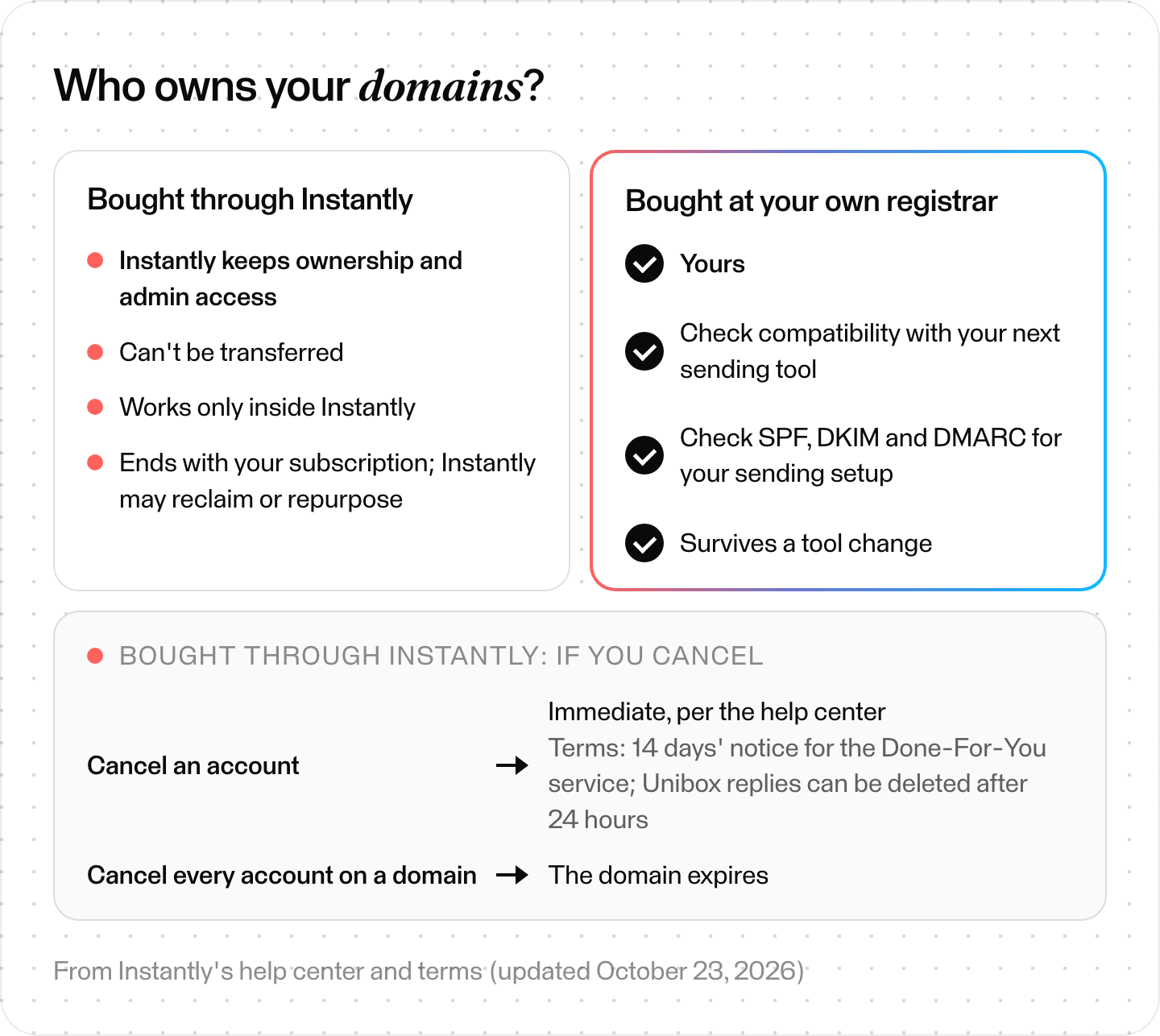
Done-for-you domains vs your own, from Instantly's help center and terms.
How do you migrate from Instantly?
Migrate from Instantly in five steps, planned around your mailboxes. Export leads, replies and opt-outs. Sort mailboxes into yours and Instantly's, and set up domains you own. Warm up while Instantly still sends, then cancel each subscription separately. New mailboxes need warm-up: Hunter's runs 30 days, and Smartlead recommends 1 to 2 months for a new domain.
Step 1: Export leads, replies and opt-outs
Save your Unibox conversations before you cancel anything. Instantly's help center says they're deleted 24 hours after you cancel a done-for-you Google or AirMail account. For a pre-warmed account, that applies once more than 30 days have passed since delivery. Carry every opt-out over: CAN-SPAM requires opt-outs to be honored within 10 business days, and that doesn't pause during a migration.
What you should see: a suppression list loaded in the new tool before any send.
Step 2: Sort your mailboxes into "ours" and "Instantly's"
Accounts you connected from your own Google Workspace or Microsoft 365 move with you. Done-for-you and AirMail accounts don't. AirMail is Instantly's own sending infrastructure, with no login outside Instantly.
What you should see: a list of domains you can keep and domains you'll replace.
Step 3: Set up replacement domains you own
Register new domains yourself and add SPF, DKIM and DMARC. Gmail and Yahoo require all three from bulk senders. Our Smartlead alternatives guide has the full rules.
What you should see: authenticated domains in your own registrar account.
Step 4: Warm up in the new tool while Instantly still sends
Keep Instantly campaigns running until the new mailboxes are warm. Every alternative above includes or sells warm-up. Our recommendation: while both tools send, add every new opt-out to the suppression list in both.
What you should see: both tools live through the warm-up period, with sending moved over gradually and the same suppression list in each.
Step 5: Cancel each subscription separately
Instantly says each subscription type must be cancelled separately, and done-for-you accounts are cancelled in the Email Accounts & Domains tab. Its terms say self-serve plans are cancelled in account settings or another mechanism Instantly designates, effective at the end of the billing period. The 30-day written-notice rule in the same section matters if you signed an Order Form.
The help center adds more rules. Outbound and Data Credits add-ons are cancelled through chat support before the renewal date. If you cancel your only plan, you keep access until the end of the billing cycle. If you have several active subscriptions, cancelling CRM or Inbox Placement ends that plan immediately.
Its terms also ask 14 days' notice to cancel the "Done-For-You" service, while the help center says cancelling done-for-you Google accounts takes effect immediately, so check which rule applies to what you bought.
Our recommendation: list the opt-out routes your sent messages offer, such as replies to the sending mailbox. Keep each one working for 30 days after the last message that offered it, then cancel. The FTC's CAN-SPAM guide says any opt-out mechanism you offer "must be able to process opt-out requests for at least 30 days after you send your message." Instantly says you lose access to done-for-you Google and pre-warmed mailboxes shortly after you cancel them.
What you should see: Outreach, Credits, CRM, Inbox Placement and mailboxes all cancelled, with no surprise renewal.
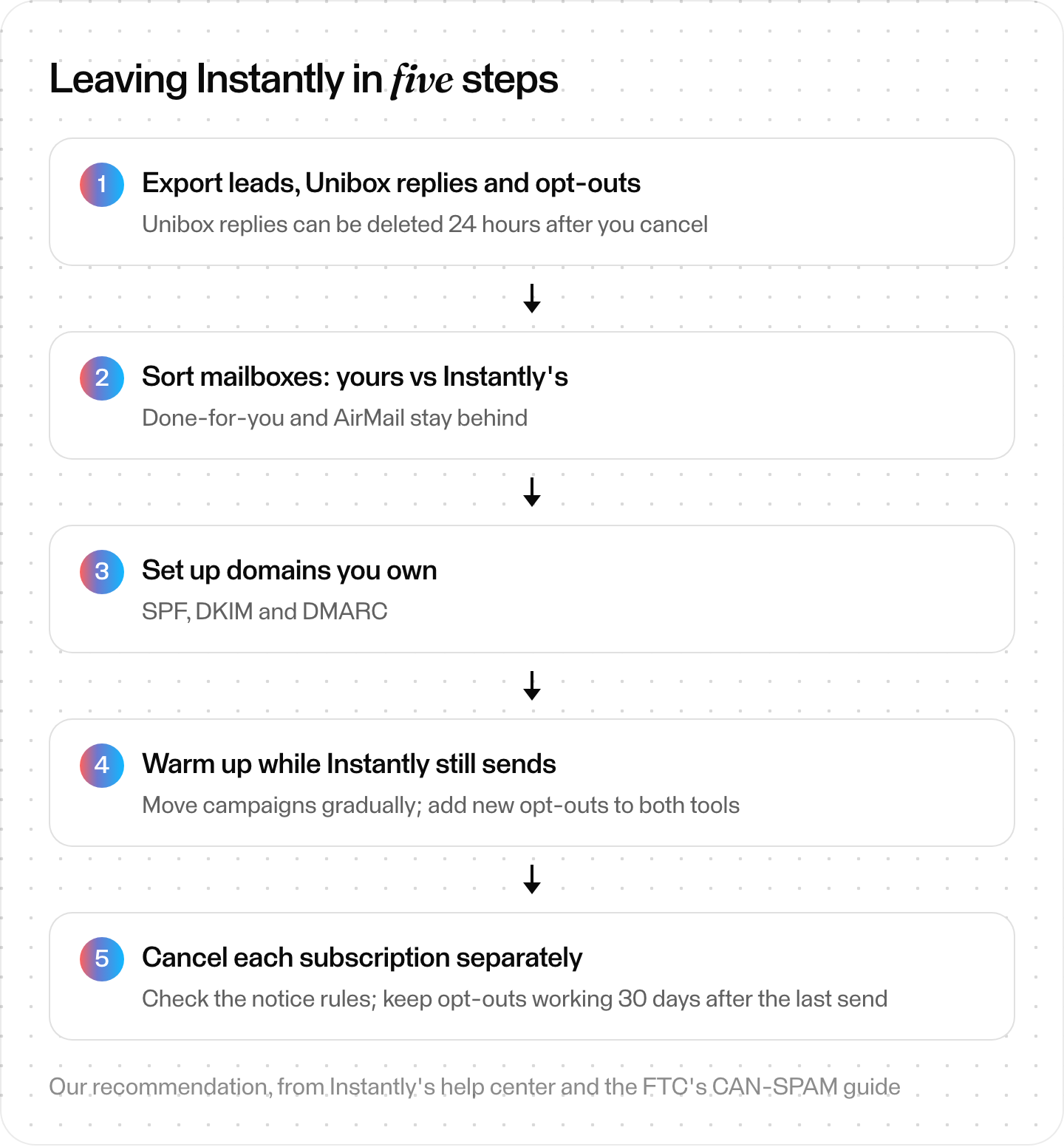
Migrating from Instantly in five steps. Our recommendation, from Instantly's help center and the FTC's CAN-SPAM guide.
Where Skygen fits (our product)
Disclosure first: Skygen is ours. Instantly sells sending, credits and CRM as separate subscriptions. Skygen is one agent that researches prospects, writes the emails and runs the sending, with the account owner approving each campaign.
- One plan, research included. Outreach Pro is $2,000 a month for 10,000 research units, shared by prospect discovery and Dossier research, and 10,000 emails, counting follow-ups. The pricing page lists a "Monthly target" of 50 leads.
- Research with sources. A Dossier reads what a prospect has published on the open web, such as their posts and their company's careers page. It keeps the source URL for every claim.
- First emails. Campaigns can send template sequences, which go out under the campaign approval. For prospects you pick, Skygen drafts an individual first email from their Dossier. It must use at least one exact Dossier fact, and its body stays at 140 words or fewer before the signature is added. A separate reviewer model checks it, and it waits for a person's approval.
- Mailboxes. Skygen assigns sending mailboxes after payment. They're rented from a mailbox provider, the way Instantly's done-for-you accounts are Instantly's.
- Sending. Each mailbox sends at most 20 emails a day (18 by default). A mailbox that isn't warmed yet ramps up over 14 days, and a lower daily limit from the mailbox provider wins. Sending rotates across healthy mailboxes. A sending domain leaves rotation when more than 10% of its mail bounces over 7 days, once it has at least 20 sends in that window. A campaign pauses itself at 5% bounces by default, counted after 100 sends.
- Replies. A person's own reply stops their sequence. An out-of-office reply only postpones the next step. It waits until the working day after the stated return date, or a week if no date is given. Agent-drafted replies go out only after a person approves them.
Our read: if you want one plan that covers research, writing and sending, Skygen is the one to pick.
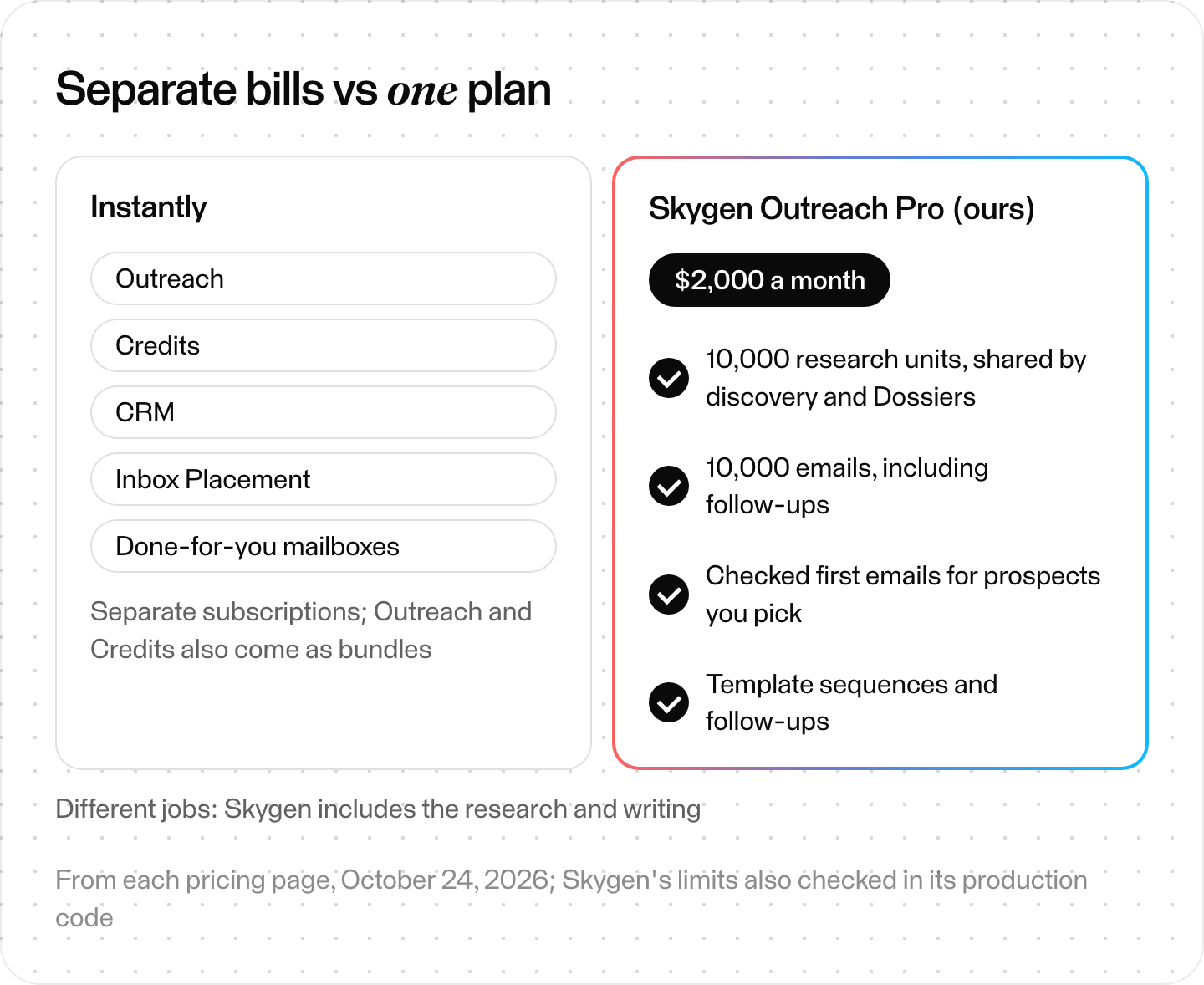
Instantly's layers vs Skygen's single plan, from each pricing page on October 24, 2026; Skygen's limits also checked in its production code.
The short version
Price Instantly as a stack: sending, credits, CRM and inbox tests are separate subscriptions, and only sending and credits come bundled. If LinkedIn matters, try lemlist or QuickMail. For data inside the plan, Apollo or Saleshandy; for data tools on their own, see our Clay alternatives. If you want free, start with Hunter or Snov.io. And before you leave, export your Unibox replies and opt-outs, and replace done-for-you domains with ones you own.