UGC stands for user-generated content. UGC creators make photos and videos that look like real customer posts, for use in your ads, product pages and emails. You pay them for content skill, not followers; Influee says they "don't need a following." Brands hire them in two main ways. One is to post a brief where creators apply (a UGC or freelance marketplace, or a platform's own program). The other is to find creators yourself and reach out with influencer outreach.
This guide covers both, step by step. It shows where to find UGC creators and what each platform charges on its own pages (read October 24, 2026; a few from archived copies, see the method note). Then come copy-ready outreach templates, what to put in a brief, how usage rights and partnership ads work, and what the FTC expects. Skygen is our product and is labeled where it appears.
Key takeaways
- UGC creators are paid for content, not reach. Influee says they "don't need a following."
- Platforms charge in different ways: Billo per video from $99, Influee plans from $229 a month plus a 10% fee on creator pay, Collabstr free with a 10% fee per hire.
- Collabstr's own marketplace data puts the average UGC package at $180 asked and $154 paid.
- Put usage rights in writing. To run ads from a creator's handle, use Meta partnership ads or TikTok Spark Ads, which the creator authorizes.
What is a UGC creator?
A UGC (user-generated content) creator makes content that looks like it came from a customer, for the brand to publish. Upwork's hiring guide puts the difference from an influencer in distribution. Influencers post to their own audience, while a UGC creator is valued for content skill, "not their follower count."
In Influee's definition, a UGC creator makes "authentic-looking" videos, photos and testimonials for ads, product pages and email. The creator doesn't post them on their own social media, and Influee adds: "They don't need a following."
| UGC creator | Influencer | |
|---|---|---|
| You pay for | The content | The content and the audience |
| Who publishes | You: ads, product pages, email | The creator, on their account |
| Followers needed | None required | No single rule; some platform programs set one (TikTok One projects: 1,000+) |
| How it reaches people | Your ads and your own channels | Their audience, plus ads if you boost it |
Billo says the line is "contractual and operational." The same person can do both, and the contract decides which you're buying.
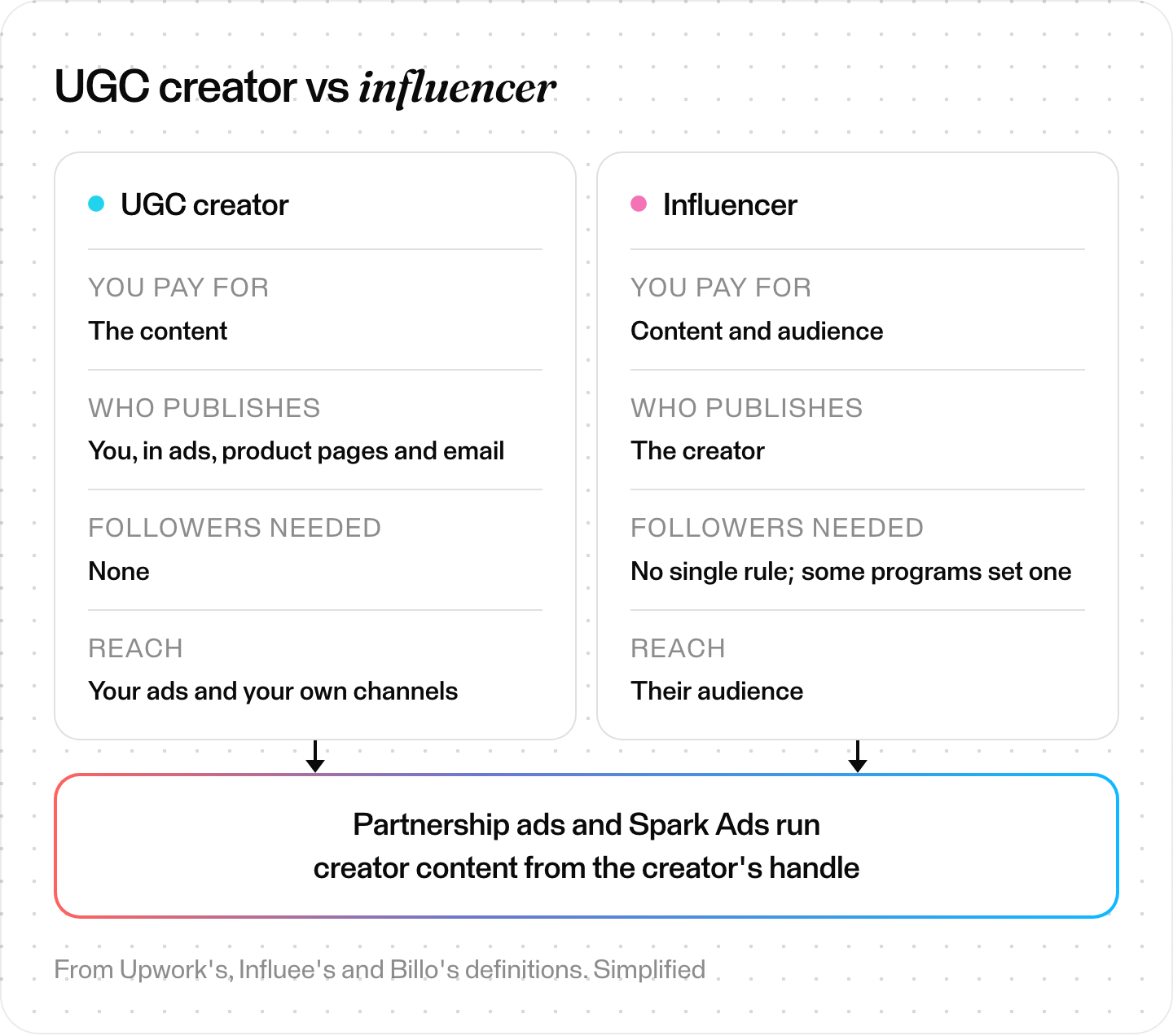
UGC creators vs influencers. From Upwork's, Influee's and Billo's definitions; simplified.
UGC vs influencer: which do you need?
Our read: pick UGC when you need ad creative to test, such as several hooks and angles you can run in your own ad account. Pick influencers when you need an audience to trust you: their followers, their voice, their channel. You can also do both: Influee says brands often pair ambassador deals with whitelisting.
Doing both means paying a creator for a post, then running it as an ad from their handle. Vendors call that "whitelisting." Meta's own name is partnership ads; TikTok's is Spark Ads. More on both below.
Where can you find UGC creators?
There are four routes. On UGC marketplaces such as Influee, Billo and Insense, creators apply to your brief. Freelance sites Upwork and Fiverr list creators too. TikTok One, Instagram's creator marketplace and YouTube Creator Partnerships are the platforms' own programs. Or find creators yourself with a discovery database such as Modash, then pitch them.
- UGC marketplaces. Post a brief, creators apply, the platform handles payment. Influee, Billo, Insense, Collabstr and JoinBrands work this way. On Collabstr, posting a campaign needs Pro ($249 a month billed annually) or Premium; the free plan hires directly from creator profiles.
- Freelance marketplaces. Upwork and Fiverr list UGC creators among other freelancers. On Upwork you set terms in the contract; on Fiverr you order a seller's gig or a custom offer.
- The social platforms' own programs.
- TikTok One absorbed the Creator Marketplace, which TikTok's business blog calls "the official platform for brand-creator collaboration." Its Creator AI Search returns up to 200 creators from a pasted brief.
- Instagram's creator marketplace is open to brands everywhere except six listed locations: Crimea, Cuba, Iran, North Korea, Syria and Russia. Brands need a verified business portfolio that holds their Instagram account and its linked Facebook page. That page must meet the eligibility rules for partnership ads and branded content. Instagram's help center adds that the feature "may not be available to you yet."
- YouTube Creator Partnerships (formerly BrandConnect): Google Ads Help says that since June 2026 its core features (Overview, Creator Search, Lists) are open to all active Google Ads accounts in YouTube Partner Program countries, with no minimum spend. Google's marketing page still says "Now testing in select markets."
- Find them yourself. Search your niche on each platform or use a discovery database such as Modash. Modash says it indexes every public Instagram, TikTok and YouTube profile with over 1K followers. Then pitch by email or DM.
Our read: marketplaces are a practical starting point. Insense, for example, says applications arrive 1 to 3 business days after a brief launches. Finding creators yourself takes more of your time but costs no marketplace commission. A discovery tool such as Modash is a subscription, and paying creators through it can add fees. It also lets you pick people who already talk about your category.
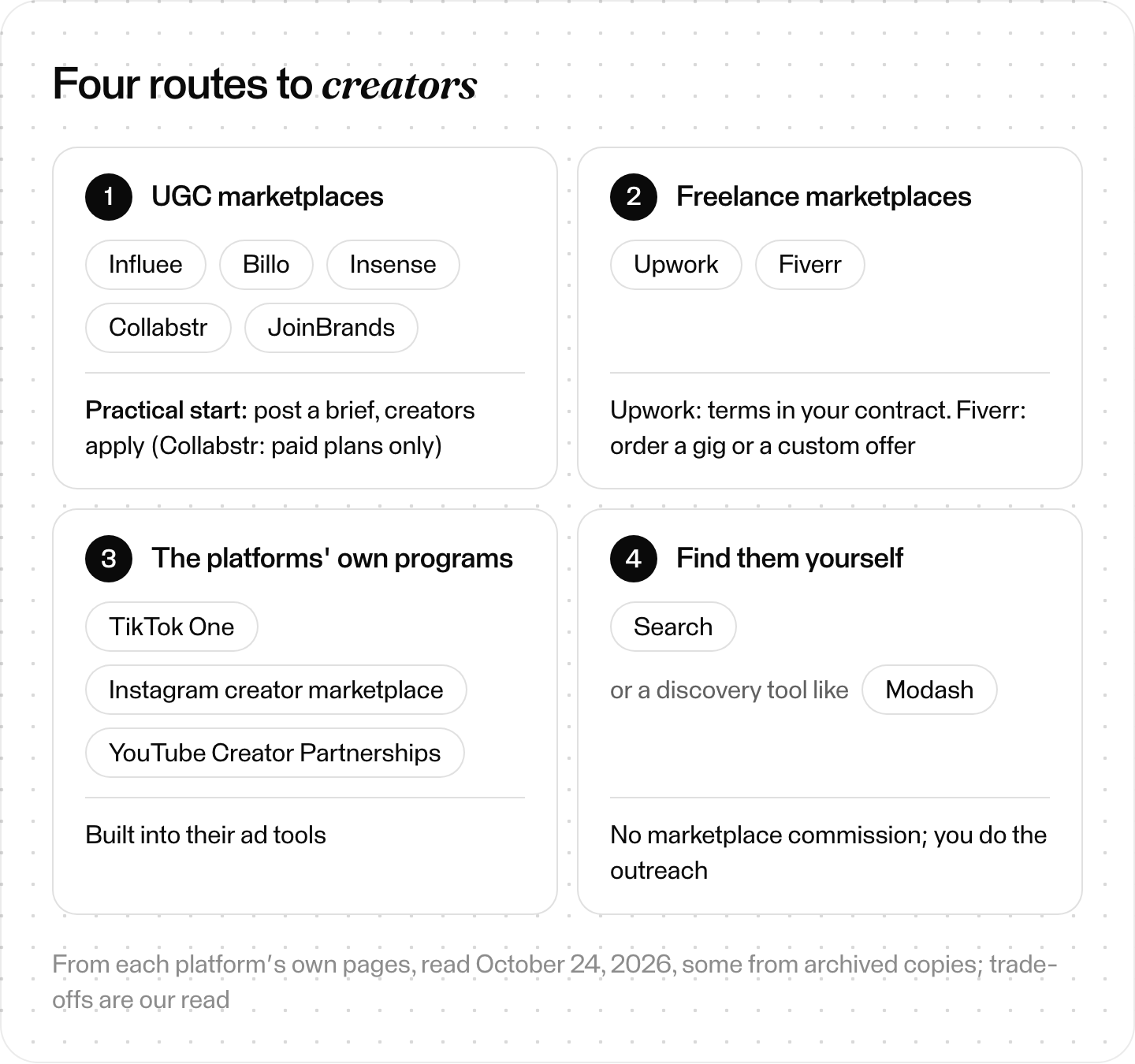
Four routes to UGC creators. From each platform's own pages, read October 24, 2026, some from archived copies; the trade-offs are our read.
How do UGC platforms compare on fees and rights?
Each UGC platform charges differently. Billo says its videos start at $99 each, with no subscription. Influee lists plans from $229 a month plus a 10% fee on creator pay. Collabstr has a free plan with a 10% fee per hire. Rights differ too: JoinBrands lists unlimited usage rights on purchased content; on Upwork, your contract sets them.
Prices and terms as displayed on each platform's own pages, October 24, 2026. Some pages were read from archived copies; see the method note below.
| Platform | How you pay | Fees | Usage rights (as the platform states them) |
|---|---|---|---|
| Influee | Plans: $229, $529 or $999 a month, plus creator pay | 10% on creator payments, held in escrow | Usage rights for all content |
| Billo | From $99 per video, no subscription; prepaid packs | Included in the video price | Yours for ads and your channels once you approve |
| Insense | Brand plan from $500 a month billed quarterly ($1,500), or $400 a month billed annually ($4,800), plus creator pay | 10% (20% on Trial, 7% on Agency) | Creator keeps copyright; brand gets perpetual digital rights (FAQ). Its feature table says "full digital copyright" |
| Collabstr | Free plan; Premium $333 a month billed annually | 10% per hire (5% on Premium); creators pay 15% | Negotiated per order |
| JoinBrands | Free pay-as-you-go; plans $99 to $499 a month | 15% on Free, falling to 8% | Unlimited usage rights on purchased content |
| Upwork | Per contract | 5% on Basic per the plan cards; an FAQ answer on the same page says 7.99% | Set by your contract; can be work for hire |
| Fiverr | Per gig | 5.5% buyer fee, plus $3.50 on orders under $200 | Not stated on the pages we read |
| TikTok One | Not stated on the pages we read | Not stated | Content Suite (global beta, through your TikTok rep): ask creators to approve 365 days of ad usage |
| YouTube Creator Partnerships | You pay the creator directly | No minimum spend | Linked videos usable in your ads once the creator accepts brand partner access; boost campaigns if boosting was negotiated |
| Modash (discovery) | Essentials $199 a month on yearly billing | Subscription; Modash Payments adds 5% on payouts above a yearly fee-free limit. Modash takes no commission from creators' approved payouts | Your contract with the creator |
Method: pages read October 24, 2026. Where a live page blocked us, we used archived copies: Upwork pricing (August 31, 2026), its UGC hiring guide (July 28, 2026) and fee help article (October 10, 2025); Fiverr fees (October 1, 2026) and UGC guidelines (August 14, 2025); Collabstr's pricing FAQ (October 14, 2026) and 2026 report (October 6, 2026).
We also used archived copies for Instagram help on partnership ads (April 21, 2026), the creator marketplace (June 10, 2026) and the paid partnership label (September 16, 2026), and for FTC pages (October 10 to 18, 2026). Billo's prices are from its blog post of October 9, 2026; its pricing page needs a login.
What do those fees mean in money? Take one $1,000 order or contract, paid in one transaction. By our arithmetic from the list prices, the buyer pays $1,050 on Upwork Basic at 5% ($1,079.90 at 7.99%), plus a $0.99 to $14.99 contract fee. By the same arithmetic, it comes to $1,055 on Fiverr, $1,100 on Collabstr's free plan or Influee (plus Influee's plan), and $1,150 on JoinBrands' free plan.
Splitting the work can cost more. Upwork charges its contract fee on each contract, and Fiverr charges its fee on every payment, plus $3.50 on each order under $200. These are buyer costs only. Creators can pay fees of their own; Collabstr, for one, charges them a separate 15% on their payout.
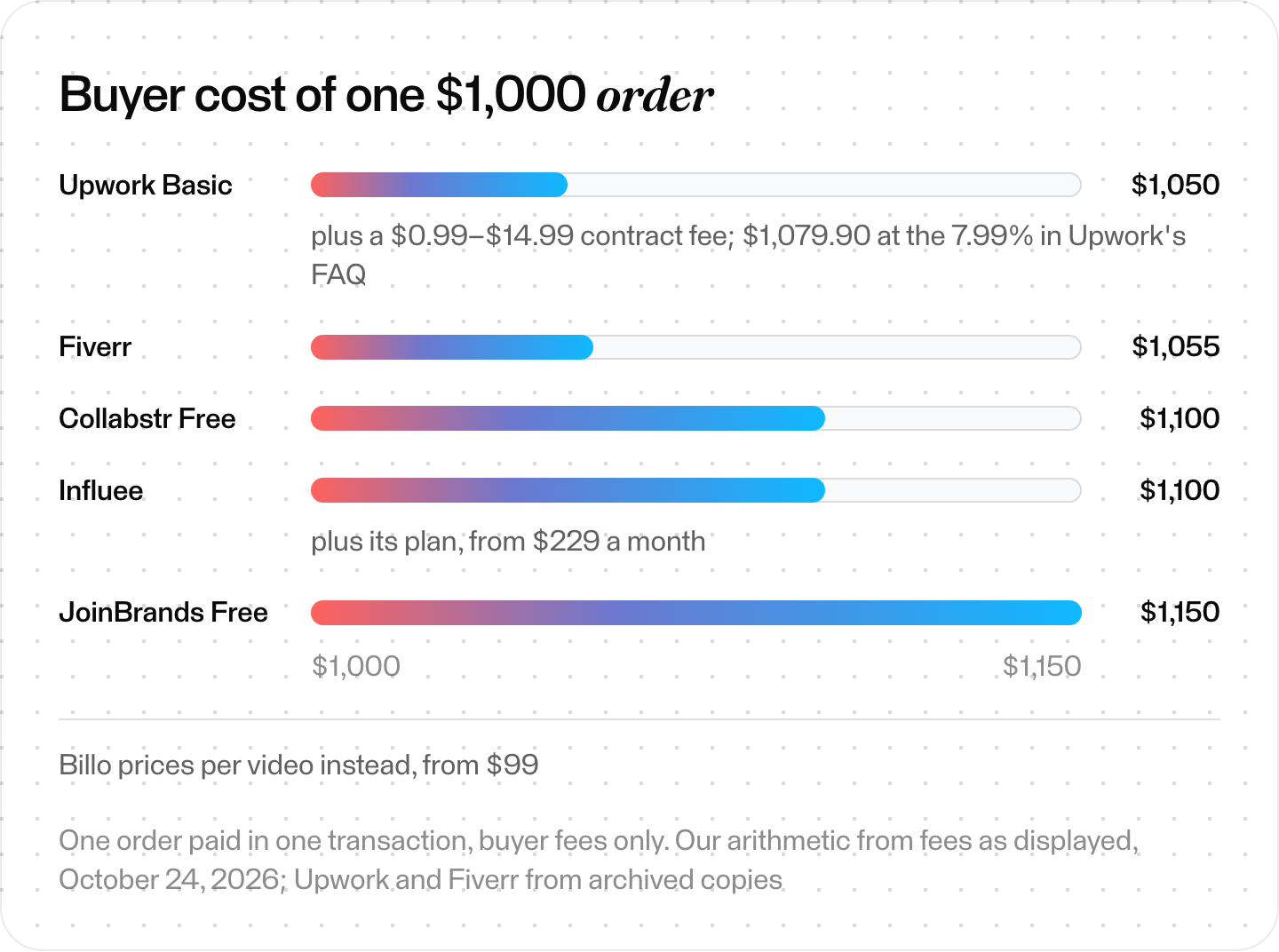
Buyer cost of one $1,000 order, paid in one transaction, on each platform. Our arithmetic from fees as displayed on pages read October 24, 2026; Upwork's and Fiverr's from archived copies of August 31 and October 1, 2026.
How much do UGC creators charge?
Collabstr's 2026 report puts the average UGC package at $180 asked and $154 paid by brands. It is the only rate data we found with a stated sample size. The report uses anonymized data from more than 21,000 collaborations on its marketplace in 2025.
- Asking price. The average UGC package was listed at $180, against $214 on Instagram, $182 on TikTok and $311 on YouTube.
- What brands paid. The average final cost was $154 for UGC.
- Campaign cost. The average UGC campaign fell 5.7%, from $209 to $197, and 80% of all Collabstr engagements, across platforms, cost under $300.
Platform starting prices sit below those averages: Billo starts at $99 per video, Insense says UGC campaigns start at $100 per video, and JoinBrands lists videos from $25. Influee's own pages disagree with themselves. Its pricing page gives a $92 average for a 30-second US video, while the FAQ on the same page budgets $57.
What moves the price, by the platforms' own descriptions: video length and format, the creator, how many creators, add-ons such as extra hooks, and the rights you want. GRIN notes that usage rights can change an influencer's rate and that exclusivity "can come at a cost."
How do you do influencer outreach that gets replies?
Influencer outreach is reaching out to a creator first, usually by email or DM. Vet each creator, then use the contact route they publish. Modash suggests opening with a personalized compliment, then a short brand intro and a yes-or-no question. Mailchimp and Skrapp both say to stop after two follow-ups.
When you find creators yourself, this is the whole job. Five steps:
Step 1: Vet before you write
Check that their recent posts match your category and format, that they label paid posts, and how they ask brands to get in touch.
Then check that they can deliver. Influee suggests looking at their production style and whether they've worked in your industry. Upwork suggests watching the first three seconds of portfolio videos to judge the hook. It also suggests reading past client feedback on reliability, deadlines and willingness to revise. Sprout Social advises researching "how each influencer likes to be approached," which is often in their bio.
What you should see: a short list where you can name the post that made you pick each creator.
Step 2: Choose email or DM
Modash advises email over DMs "wherever possible" and says most creators list an email in their bio. GRIN calls mass DM outreach the least ideal option. Influee suggests DMs for nano and micro creators and email for deals above €500.
What you should see: one contact route per creator, the one they published.
Step 3: Write a short first message
The vendors' advice agrees on the shape:
- Open with them. Modash's formula is a personalized compliment that shows research, a short brand intro and a simple yes-or-no question.
- Say why and what. GRIN says to explain why you chose the creator and to state the ask with an initial compensation offer.
- Keep it short. Mailchimp advises subject lines under 50 characters and a first email of 150 to 200 words.
- Say whether it's paid. Skrapp advises saying so in the first message.
They disagree on one subject line. Mailchimp says to avoid "Collaboration Opportunity"; Sprout Social's example is "Collaboration Opportunity with [Your Brand]." Our read: write something specific to the creator instead.
What you should see: a message the creator can answer with one word.
Step 4: Follow up, then stop
Advice varies here. Mailchimp suggests a brief follow-up after 5 to 7 days and no more than two. Skrapp says wait 5 to 7 business days and stop after two. Influee says one follow-up, 5 to 7 days later. Our recommendation: one follow-up after a week, a second a week later, then stop.
What you should see: every creator contacted at most three times.
Step 5: Put the deal in writing
Skrapp advises confirming deliverables, timeline, compensation, usage rights and disclosure in writing. Sprout Social says to put content costs and usage rights in the contract.
What you should see: a signed agreement or an accepted platform order before the product ships.
About reply rates: Influee says 10 to 30% is a good response rate for well-targeted, personalized messages. Skrapp expects 20 to 35% positive replies from a vetted, personalized list with follow-ups, but neither publishes how it measured that. We found no benchmark with a stated method.
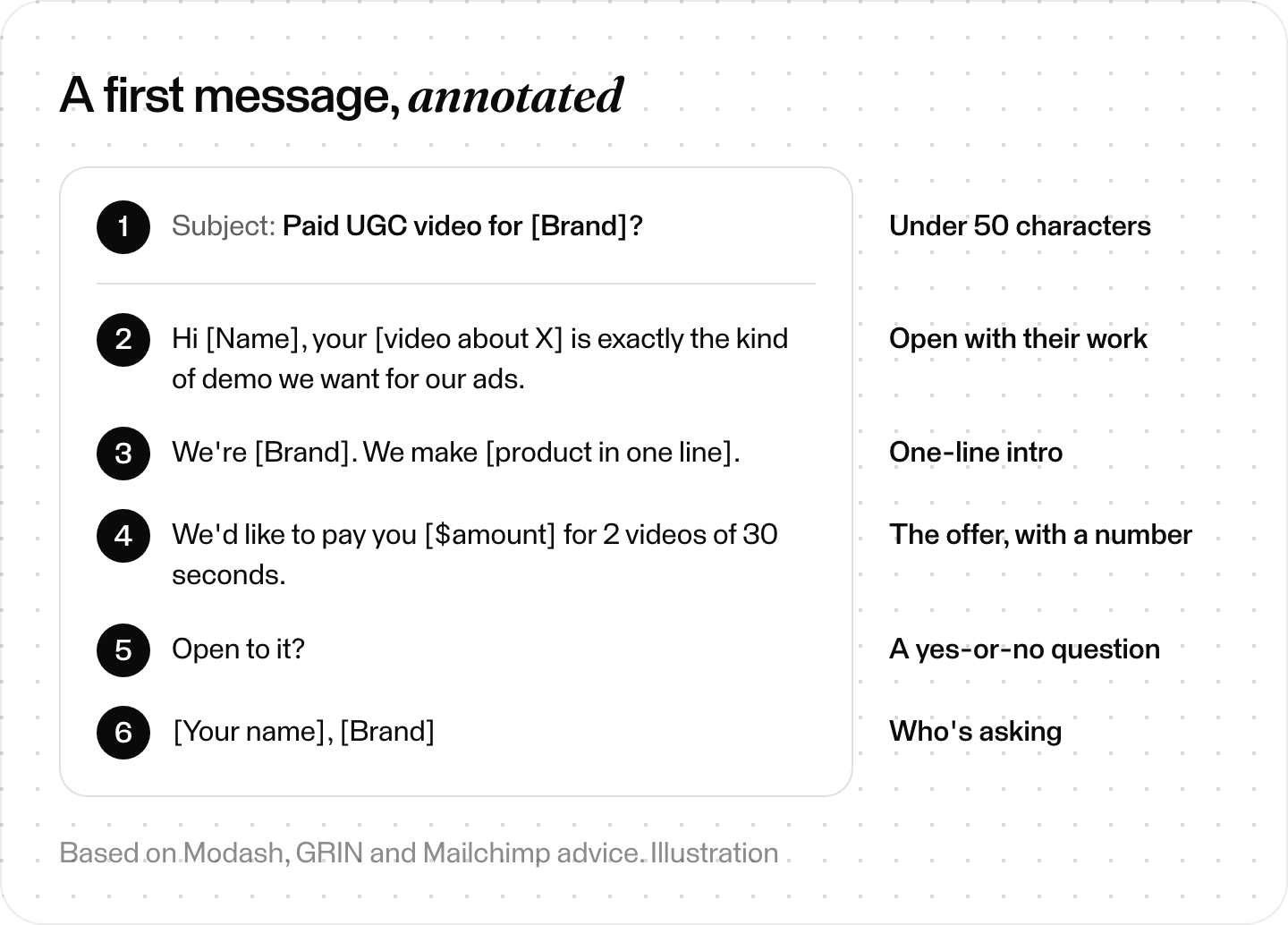
The shape of a first outreach email. Based on Modash, GRIN and Mailchimp advice; illustration.
Influencer outreach email templates
These four are ours. Swap the brackets for real details, and keep the reason you picked the creator specific.
Before you send, check CAN-SPAM. The FTC's compliance guide says what matters is the message's "primary purpose." The law covers email whose primary purpose is advertising or promoting a commercial product or service. Whether a pitch to a creator qualifies depends on that, and these templates don't settle it.
If yours is covered, it needs accurate sender and routing details, a subject line that reflects the content and a clear statement that it's an ad. It also needs your valid physical postal address and a clear way to opt out of future marketing email, honored within 10 business days. For sending at volume, check what Gmail, Yahoo and Outlook require from bulk senders in our Smartlead alternatives guide.
1. Paid UGC video (you run it, they don't post)
Subject: Paid UGC video for [Brand]?
Hi [Name], your [video about X] is exactly the kind of [demo/unboxing] we want for our ads.
We're [Brand]. We make [product in one line]. We'd like to pay you [$amount] for [2] vertical videos of [30] seconds, used in our paid ads for [6 months]. We'd ship the product first.
Open to it? If yes, I'll send a one-page brief.
[Your name], [Brand]
2. Paid post plus ad rights
Subject: [Brand] x [Name]: paid post?
Hi [Name], your [specific post] is why I'm writing.
We'd like to pay [$amount] for one [Reel/TikTok] about [product], posted on your account with the paid partnership label. The video itself would need a clear disclosure that it's a paid ad. We'd also like to run it as an ad from your handle for [30] days, for [$amount] more.
Interested? I can share the brief and terms.
[Your name], [Brand]
3. Gifting (product only)
Subject: Can we send you [product]?
Hi [Name], we liked your [post]. We'd like to send you [product], no obligation to post.
If you do post about it, please say it was a gift, for example Gifted by [Brand], and tag @[brand].
Want one? Reply with a shipping address.
[Your name], [Brand]
4. Follow-up
Subject: Re: [original subject]
Hi [Name], bumping this in case it got buried. Still keen on [one-line offer]. If it's not a fit, a quick "no" is fine and I won't write again.
How do you brief a UGC creator?
A brief turns a yes into the video you need. Influee advises not attaching it to the first message; send it after the creator agrees. Keep it to one page: deliverables, the angle, what they may say, dos and don'ts, usage rights, disclosure, revisions and dates, and payment.
- Deliverables: how many videos, length, aspect ratio, and whether you want raw files.
- The angle: the problem, the moment the product helps, two or three hooks to try.
- What they may say: only true product facts. The FTC says an endorser can't talk about experience with a product they haven't tried.
- Dos and don'ts: brand words, competitors not to mention, claims to avoid.
- Usage rights: organic, paid ads, website and email, and for how long.
- Disclosure: how to label the post if they publish it.
- Revisions and dates: Billo includes two revisions within the brief, and Insense allows up to three.
- Payment: amount, when it's paid, and through which platform.
What you should see: an agreed brief, with open questions resolved before filming starts.
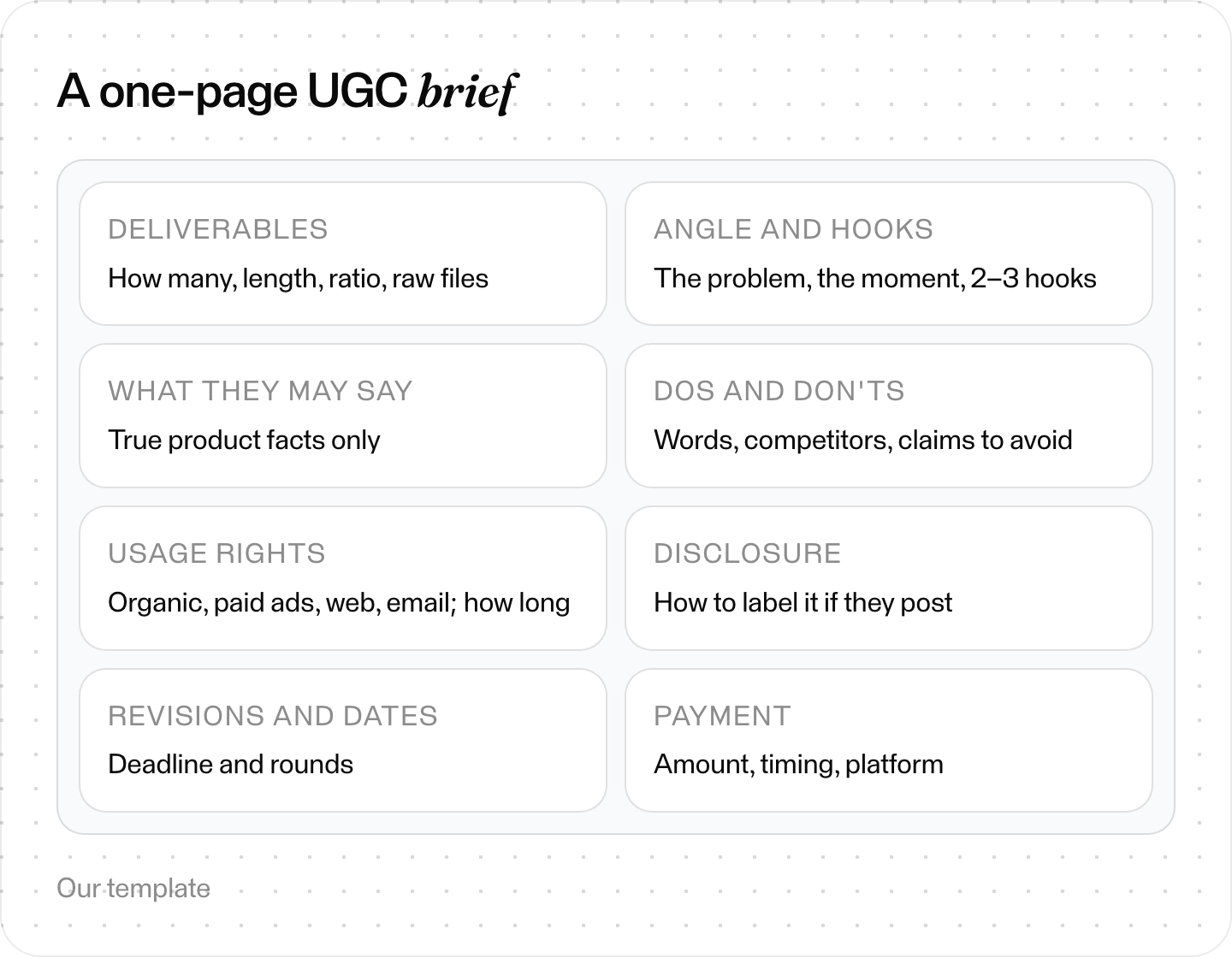
A one-page UGC brief. Our template.
What do UGC usage rights, whitelisting and partnership ads cover?
UGC usage rights decide what you can do with the content after you pay, such as organic posts, paid ads or your website. Whitelisting is the industry shorthand for running ads from a creator's handle. Meta calls these partnership ads and TikTok calls them Spark Ads; both need the creator's permission.
Platforms state usage rights differently:
- Billo: "Once you approve a video, the licensing rights are yours to use in ads and on your channels."
- Insense: its FAQ says the creator keeps copyright and grants the brand perpetual digital rights. Its feature table says "full digital copyright." Ask which applies to your order.
- Upwork: depends on the contract, which can be structured as work for hire. Upwork advises defining organic, paid-ad and website use.
Meta partnership ads. Meta's help page says "Branded content ads are now called partnership ads." They run with the creator's account in the ad's header, and the creator must give permission, which they can revoke at any time:
- Content-level permission covers one post, story or reel. The creator switches on "Allow brand partner to boost," or shares a partnership ad code, which works for up to 2 advertisers at a time.
- Account-level permission lets you create ads from their handle without an existing post. If they revoke it, ads already running pause.
TikTok Spark Ads. TikTok's help center gives the steps: the creator turns on ad authorization for a post and generates a video code. They pick a duration of 7, 30, 60 or 365 days, then share the code with you. Once authorized, the caption can't be edited, and a private video becomes public if used in a campaign. When the authorization expires, TikTok's fix is to ask the creator to extend it.
"Whitelisting" is the industry shorthand for both. Insense calls it "Meta Partnership Ads (previously whitelisting)." Use the platforms' own names in contracts. Once a partnership ad runs in Meta, our guide to automating Facebook ads with an AI agent covers budget rules and guardrails.
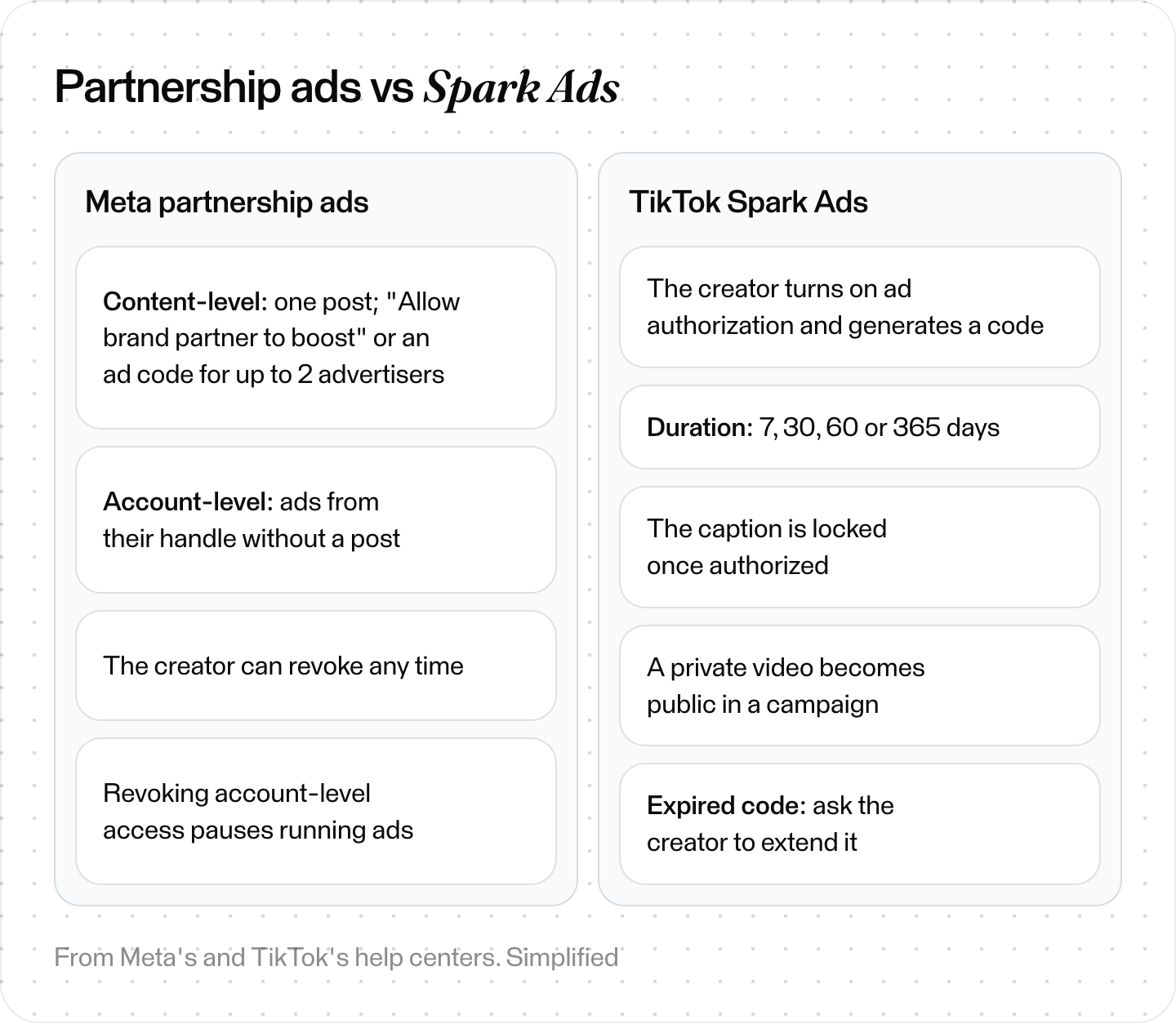
Partnership ads vs Spark Ads. From Meta's and TikTok's help centers; simplified.
What does the FTC require from brands and creators?
If creators post about you on their own accounts, the FTC's Endorsement Guides apply, and the FTC holds the brand responsible too. Creators must clearly disclose any material connection, such as payment or free or discounted products. Brands should tell them how to disclose and monitor their posts.
The Guides aren't law in themselves, but the FTC can bring cases against practices that conflict with them. Its Disclosures 101 guide and its FAQ for businesses say:
- Disclose the connection. Creators must make clear any "material connection" to the brand, including being paid or getting free or discounted products.
- Make it hard to miss. The disclosure goes with the endorsement itself. A profile page or a "more" link isn't enough, and in a video it belongs in the video.
- Use plain words. "Ad," "advertisement" or "sponsored" are often enough if placed where they're hard to miss; avoid "sp," "spon" or "collab." Don't rely on a platform's disclosure tool alone.
- Brands train and monitor. Advertisers need reasonable programs to tell creators what they may claim and how to disclose, and to check posts.
- Gifts count. A brand sending free product should ask for a disclosure, explain how, and monitor posts. "Gifted by XYZ" works when only a free product was received.
- Customer comments in your ads. The FTC's FAQ says you can feature customers' comments in your ads. "If they have no reason to expect compensation or any other benefit before they give their comments, there's no need to disclose your payments to them." However, "if you've given these customers a reason to expect a benefit from providing their thoughts about your product, you should disclose that fact in your ads."
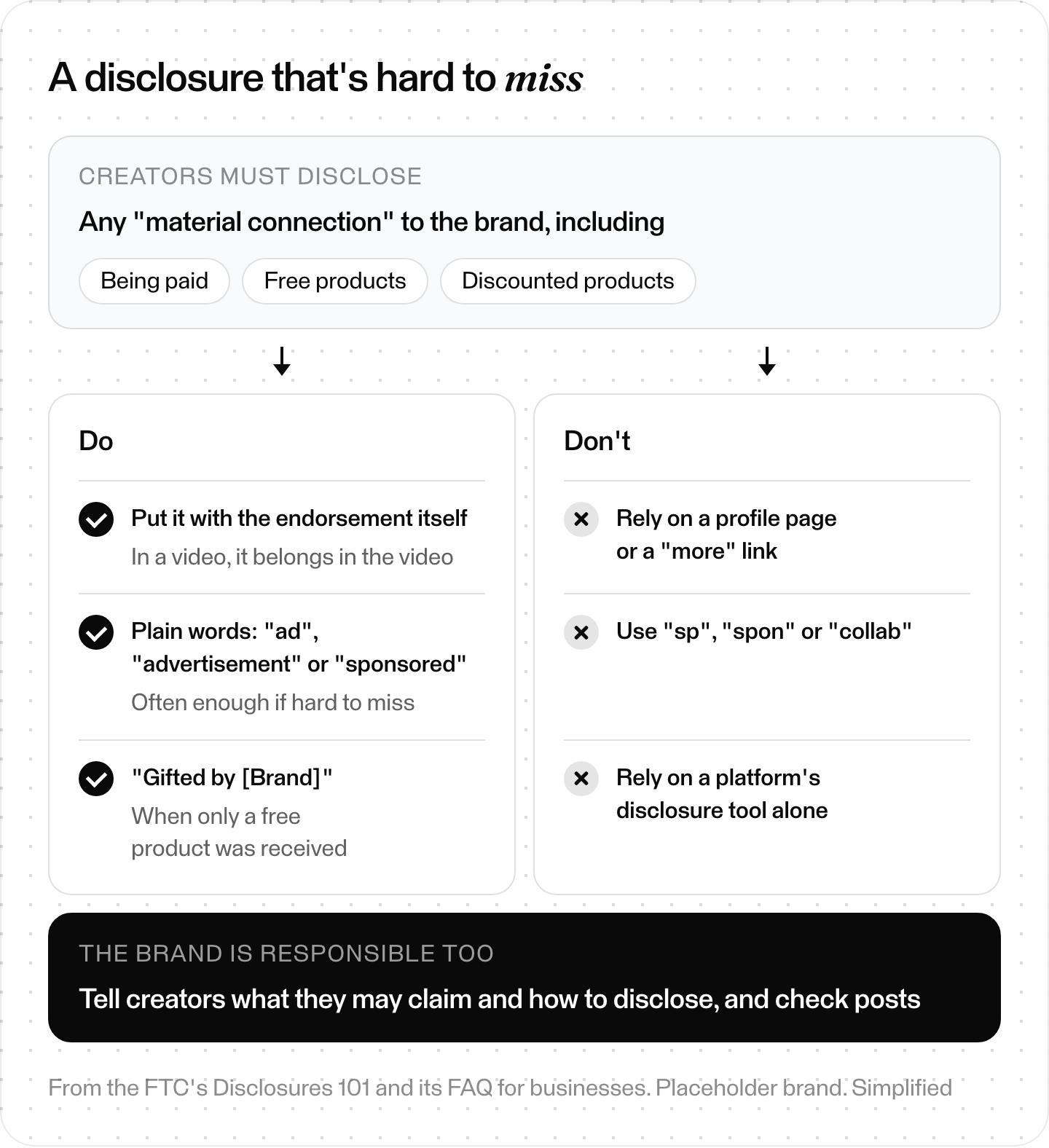
Disclosing a brand connection, and the brand's part. From the FTC's Disclosures 101 guide and its FAQ for businesses, read from archived copies; placeholder brand; simplified.
For UGC you run as your own ads, the FTC's rule on consumer reviews and testimonials, in effect since October 21, 2024, also applies. It bans fake reviews and testimonials, including AI-generated ones, bans incentives conditioned on a review expressing a particular sentiment, positive or negative, and bans buying fake followers or views the buyer knew or should have known were fake, for a commercial purpose.
It also bars using a testimonial the business knew or should have known materially misrepresents that the person used or had experience with the product. The FTC adds that the rule "does not prohibit using an actor to portray a real testimonialist."
This is a summary of the FTC's own guidance, not legal advice.
How to evaluate UGC after publication
Influee's hiring guide says to define your KPIs: "This is what you will use to assess the performance of the UGC campaigns." It suggests judging the content from each creator on views and watch time, click-through rate and conversion rate.
Our read: agree on these measures before you commission more content, so every creator is judged on the same numbers.
Where Skygen fits (our product)
Disclosure first: Skygen is ours. Its creator agent runs the find them yourself route for you, from research to an agreed offer and a scan of the published post. It sends nothing you haven't approved. Skygen's pricing page describes Influence Starter this way: "Your agent finds relevant creators and drafts personalized pitches."
- Finds creators in your niche on YouTube, TikTok and Instagram.
- Writes each pitch from their work. A letter is anchored to a post Skygen actually read, with its URL. When it couldn't read a post, it falls back to the creator's bio or a public search excerpt about them and says which. Letters aim for 70 to 95 words (never more than 120). They may not invent an agreed budget, deadline, usage rights, audience, product feature or result.
- Keeps the offer consistent. Offers are worked out from a price table, Skygen's default ($20 per 1,000 views, half up front) until you set your own. Once a creator joins a campaign, the figure is frozen, so every follow-up quotes the same number.
- Reads counter-offers by rule, not by a model. Out of the box nothing is accepted automatically; you decide.
- Asks before it sends. A one-off email to a creator goes out only after you approve that exact saved text. It also needs published contact proof that matches the creator's business address, and a connected mailbox your account owns. Creators you add to a campaign get its reviewed letters on the campaign's schedule once you approve sending.
- Never holds creator money. On Influee and Upwork, payment stays on those platforms. On a direct deal, Skygen records what you say you paid.
- Scans the published post. After a creator publishes, Skygen can re-read the post's public text and flag sponsorship markers such as #ad or "paid partnership," which helps with the post checks the FTC expects from brands.
Skygen can also post your brief to Influee or Upwork once those connections are set up.
Influence Starter is $67 a month for 100 creator profiles researched, 50 drafting credits for checked pitches and 100 emails. Influence Pro is $299 a month for 1,000 profiles, 500 drafting credits and 1,000 emails. Creator fees are separate.
Our read: if you want the find-them-yourself route without doing the research and pitching by hand, Skygen is the one to pick.
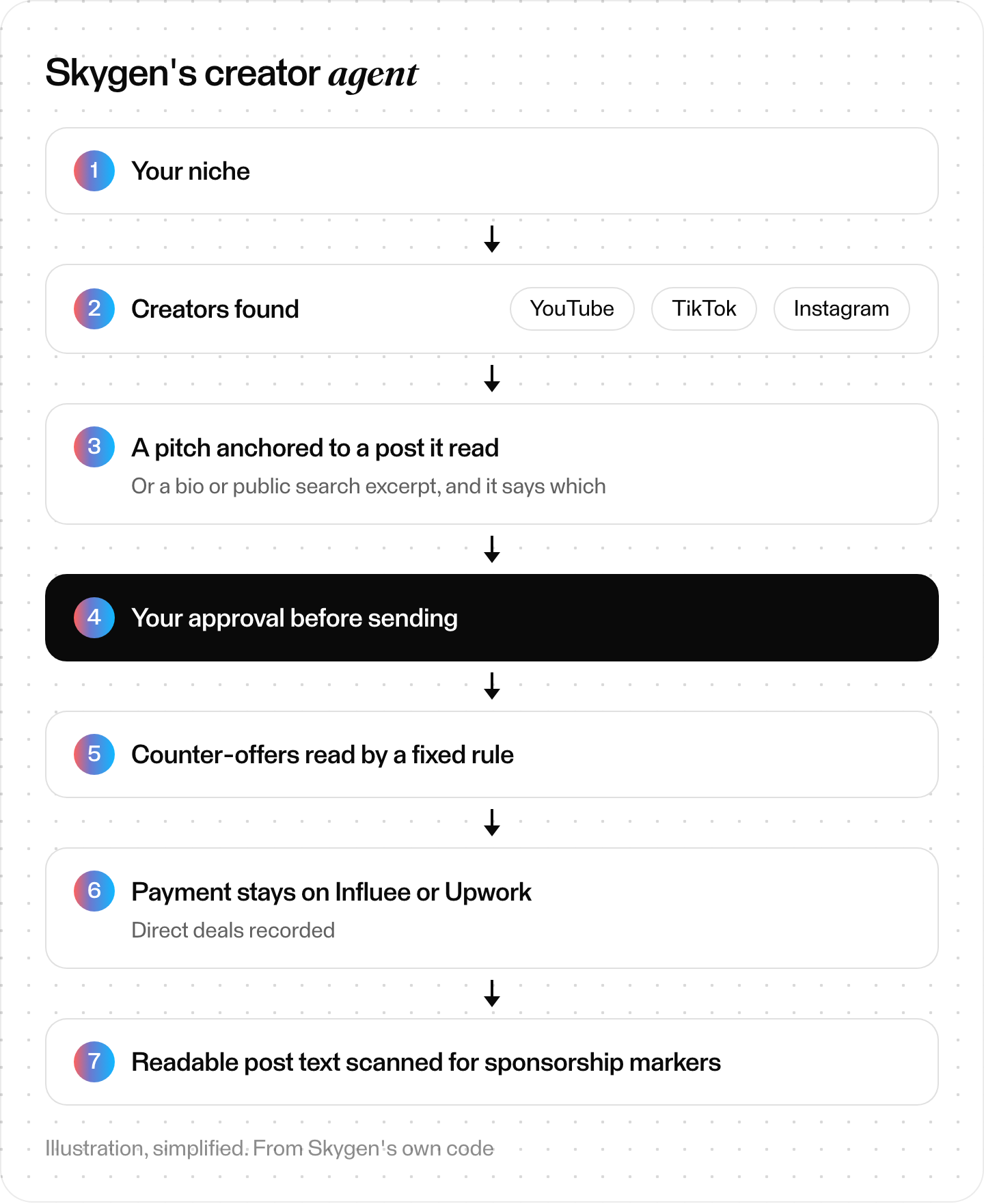
Skygen's creator agent. Illustration, simplified.
The short version
Decide whether you're buying content (UGC) or content plus an audience (influencers). Use a marketplace as a practical starting point, or find creators yourself to skip marketplace commissions. Pitch with a short, specific email that names the post you liked and the money involved. Follow up twice at most. Put deliverables, rights and disclosure in writing before anything ships, and agree how you'll measure the results.